
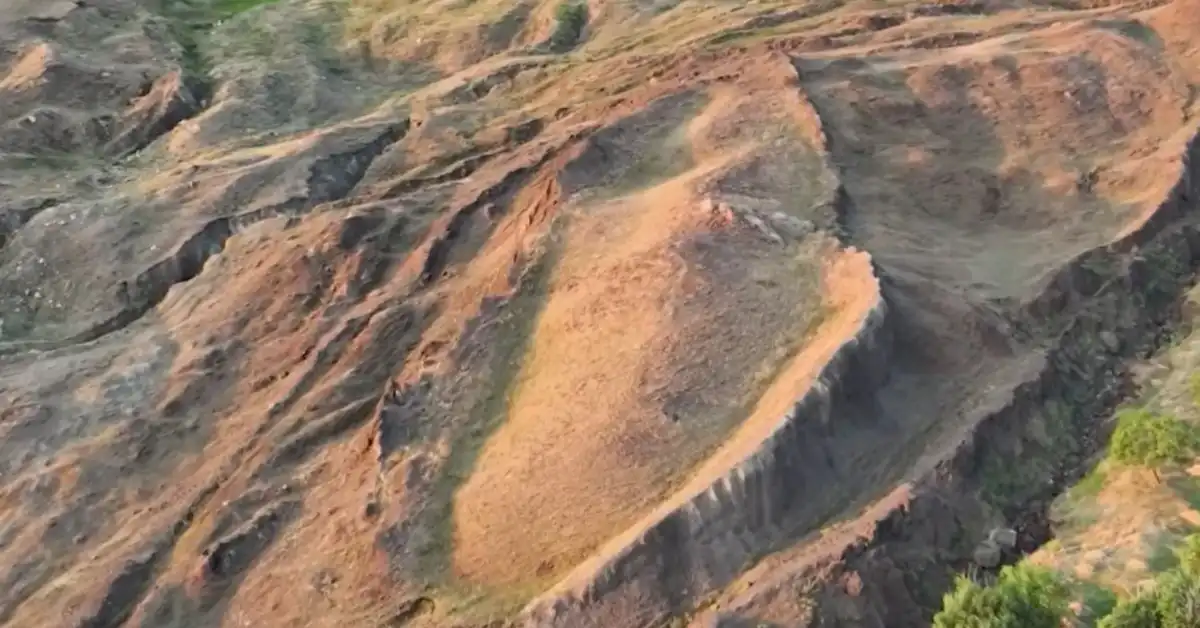

Andrew Jones has spent years searching for the remains of Noah’s Ark. This year, his team pulled charred and uncharred wood from nearly 30 feet underground at a site in eastern Turkey. The find drew international attention. Then came the knocks on his door in the middle of the night.
Jones, founder of Noah’s Ark Scans, says the harassment began shortly after his team announced it had received an official permit from the Turkish government to study the Durupınar Formation near Mount Ararat. What started as a single late-night disturbance turned into repeated threats and eventually a burglary that stripped his apartment of laptops, computers, and memory cards.
A Late-Night Knock and a Warning
Jones described the first incident in an interview with NewsNation’s Meagan Medick, recalling the fear of being woken up by someone outside his door.
“It was like 1 or 2 in the morning, and the first time it happened, I thought it was just some kids or somebody just messing with me.”
The intruder was not a local kid. Jones said the person outside his door was shouting profanities in English, which was not their first language. The words were clear enough to be threatening. After the first incident, Jones called a friend to come over and check the building. No one was found. About a week later, the same thing happened again at roughly the same hour. This time, a different friend arrived with a gun and searched the apartment building and the street outside. Still nothing.
Jones decided to leave the apartment for good. He told Medick that after the second incident, he was sure the harassment was deliberate.
“The second time, okay, they’re doing this on purpose. It’s targeted towards me for whatever reason. And I decided to leave, and I didn’t come back to that place.”
The threats did not stop when he left. While Jones was traveling with a group in Southeast Turkey, a friend called him early in the morning with bad news. His apartment had been broken into again. This time, the intruders did not just knock. They went inside.
Break-In and Stolen Research
Lauren Witzke, the director of fundraising for Noah’s Ark Scans, announced the burglary on September 26, 2026, in a post on X. According to Witzke, Jones had been woken up repeatedly between 1 a.m. and 3 a.m. by people banging on his door, trying to get in, and threatening to kill him. She urged him to stay with a friend while the 2026 study continued.
While Jones was away, intruders ransacked the apartment. Witzke said the thieves took his laptops, his computers, and his memory cards, essentially anything they thought might hold the Noah’s Ark research data. Other valuables, including a microphone and a printer, were left behind.
“They specifically knew what they were there for,” Witzke wrote on X.
Jones confirmed the burglary to Newsweek but declined to speculate on who was responsible.
“My apartment was broken into while I was away. Devices were taken; the research data had already been copied. My friend reported it to the local police while I was away and I am not going to guess who did it.”
The police told Witzke that security cameras at the apartment complex were not working during the break-in. No suspects have been publicly identified, and the team’s belief that the burglary specifically targeted its research has not been independently confirmed by authorities.
Jones also told Charisma Media that he does not want the incident to reflect poorly on Turkey or the people living near the excavation site. He said the team works with Turkish partners under official authorization, and the study has continued with laboratory work through the winter.
The 30-Foot Wood Discovery Explained
The break-ins and threats unfolded against the backdrop of a significant reported find. In late October 2026, researchers with Noah’s Ark Scans announced that they had recovered both charred and uncharred wood from nearly 30 feet (about 9 meters) below the surface of the Durupınar Formation.
Jones told the Daily Mail that the material could potentially be the remains of the biblical vessel.
“It is possible that we have found the charred remains of Noah’s Ark.”
He also offered a more ordinary explanation. The burnt wood could have come from a shepherd’s campfire, lit centuries ago by someone using the formation as shelter. The team said the wood could have been burned deliberately, struck by lightning, or exposed to volcanic activity in the region.
The charred condition of the wood has drawn particular interest. According to the biblical account, Noah was instructed to coat the ark inside and out with pitch, a waterproofing substance that is also flammable. The researchers have suggested that a fire may have damaged the vessel at some point, and that the charring could have helped preserve the wood by slowing its breakdown in the soil.
Professor Cenker Atila of Sivas Cumhuriyet University, the lead archaeological professor overseeing the officially permitted project, confirmed at a symposium in eastern Turkey that the wood samples have been sent for carbon-14 dating and species identification.
What the Radar Scans Showed
The wood was not the only reported finding. Dr. Khosrow Bakhtar, a veteran U.S. defense scientist, conducted advanced radar scans of the formation using a system called BakhtarRadar. Bakhtar said the scans revealed organized patterns, chambers, and corridors inside the roughly 515-foot-long boat-shaped structure, and that these features are not geological.
“This is the most significant finding of 45 years of my career. It’s not geologic related, because we masked all the geologic features,” Bakhtar said.
Atila also told media at the symposium that the radar studies identified a formation with three levels beneath the surface, a detail that caught attention because the biblical account describes the ark as having three levels.
Jones said the preliminary radar readings extended approximately 95 meters (about 312 feet) below the surface in some locations. He described repeating underground features, including groups stacked one beneath another. Nearly 400 soil samples collected from different depths are awaiting further analysis.
Carbon Dating Tests Underway
The wood samples are currently in laboratories for carbon-14 testing, a scientific method used to estimate the age of organic material. The tests will determine whether the wood is ancient, what type of wood it is, and whether it could plausibly be connected to a structure thousands of years old.
Researchers have stressed that no firm conclusions should be drawn until the laboratory results are complete and published. What can be stated at this stage, according to the team, is that the material was recovered from deep within the formation and is not recent surface debris or material carried in by mudflow.
The team has also acknowledged that the formation could have a natural explanation. Earlier geological studies concluded that the unusual ship-like shape was formed through landslides and erosion. The latest discovery has not overturned those findings, because the wood’s age and its connection to any ancient structure remain unknown.
Fundraising and Official Permits
Noah’s Ark Scans is an American Christian group that operates under a permit from the Turkish government, working in partnership with Sivas Cumhuriyet University. Jones said it took years to secure the permit, and once it was approved, the team had about one month to raise funds and organize the expedition.
As of September 27, 2026, the group had raised over $100,000 on the crowdfunding platform GiveSendGo, against a total target of $600,000 for the expedition.
Witzke said the team had backed up its research data before the burglary, and none of the evidence was lost.
“Andrew is safe, the research is safe, we are not backing down and we won’t be scared into quitting the most important scientific study in world history.”
Geologists Remain Skeptical
The claims from Noah’s Ark Scans have not persuaded everyone. Prominent geologists have long dismissed the Durupınar Formation as a natural rock formation. Some critics have pointed out that the team has released findings on social media before publishing them in peer-reviewed scientific journals.
Jones himself has been careful to separate belief from proof. He has said he personally believes the site is the best candidate for the ark’s resting place, but he has also acknowledged the findings that would challenge that belief, including the possibility of continuous shallow bedrock across the site.
You May Also Like





View all articles about
The wood samples are now in the lab. The carbon-14 results will determine the next stage of the investigation. Until those results are published, the question of whether the Durupınar Formation holds the remains of Noah’s Ark remains open.
Also Read: Matthew Wright GoFundMe Passes $73,000 as Ellen DeGeneres Show Producer Dies at 52
For more updates on this story and other entertainment news, keep reading VvipTimes.




































Leave a Reply