
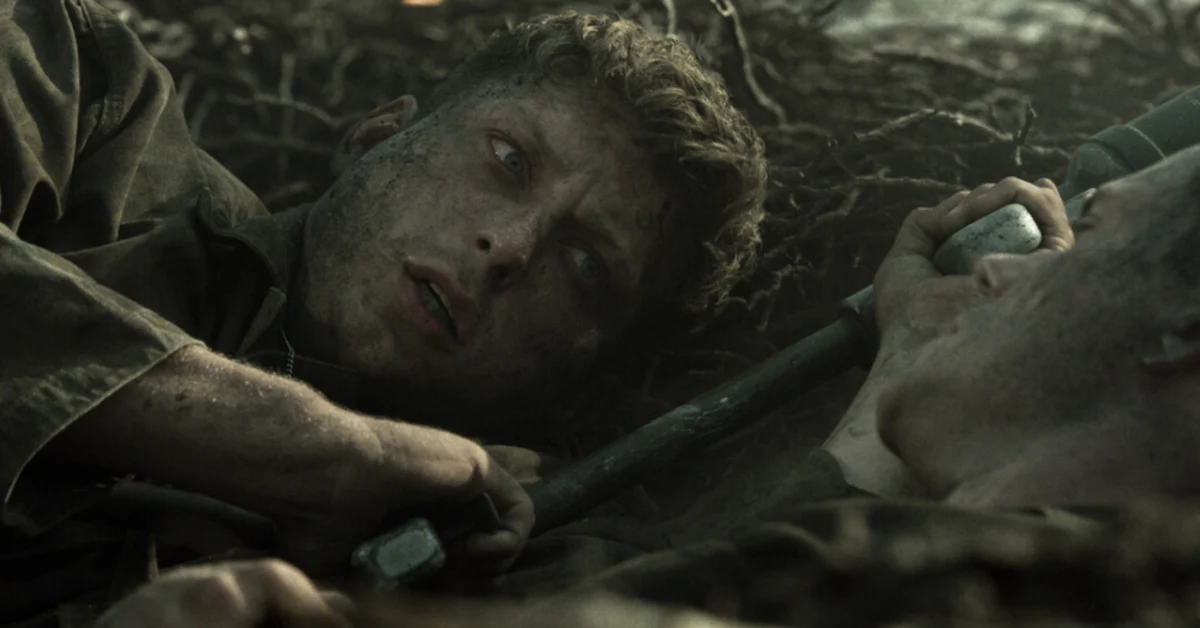

Tom Francis trained for months to play a college football star turned Marine in The Mosquito Bowl. He spent hours on the gridiron and in military boot camp alongside his co-stars. The one thing he did not prepare for was a fully staged musical number.
Director Peter Berg added a scene at the last minute that features Francis singing in a bar before the men ship off to war. The moment was not in the original plan for the film, which tells the true story of four college football players who joined the Marines during World War II. Berg decided to use Francis’s Broadway background after casting him as David Schreiner, a Wisconsin football star who was killed in action in 1945.
A Song Learned Overnight
Francis, a Tony-nominated actor for his role in the Broadway revival of Sunset Boulevard, had no idea the bar scene would become a full production. Berg sent him the song and told him to learn it for the next day. “I thought it was going to be around a campfire,” Francis said. “I didn’t realize it was going to be fully staged”.
The real David Schreiner was not a singer. Berg created the scene specifically to highlight Francis’s vocal talent, which he had showcased on London’s West End and on Broadway in shows like Rent, & Juliet, and Hair. The singing moment arrives before the characters leave for the Pacific theater, giving audiences a brief glimpse of normal life before the combat sequences begin.
Making War Feel Real, Not Glorified
The battle scenes in The Mosquito Bowl are not easy to watch. The film shows the landing on Tarawa and the fighting on Okinawa with a level of detail that several critics have described as unflinching and, at times, overwhelming. Francis said the goal was never to make war look heroic.
Cinematographer Jacques Jouffret told Francis directly that he did not want to romanticize the battlefield. “We bought loads and loads of palm trees, but I’m not shooting the palm trees. We’re setting them on fire,” Jouffret said. “We can’t glorify this. It has to be as true to what they went through as possible”.
Francis described the final result as “visceral and intense” and admitted the footage is “uncomfortable at points”. Berg told The Athletic that his goal was immersion. “There can be times in movies, if you’re the audience, where you stop being a spectator, and you actually feel like you’re participating, and you’re not necessarily safe,” Berg said. The landing scene on Tarawa has been compared to the opening of Saving Private Ryan, while the close combat evokes Hacksaw Ridge.
The True Story Behind the Mosquito Bowl
The film is based on Buzz Bissinger’s 2022 nonfiction book The Mosquito Bowl: A Game of Life and Death in World War II. The title refers to a football game played on Christmas Eve in 1944 on the island of Guadalcanal. Two Marine regiments, the 4th and the 29th, faced off in front of about 2,500 service members. The game ended in a scoreless tie and was broadcast live over the radio.
Most of the 65 Marines who played in the game had college football experience. Three All-Americans and seven former college captains took the field. Of those 65 players, 15 were killed in the Battle of Okinawa that followed. The four men at the center of the film are John McLaughry (played by Nicholas Galitzine), Bob Bauman (Bill Skarsgård), Tony Butkovich (Ray Nicholson), and David Schreiner (Tom Francis). Only McLaughry survived the war.
Francis said playing Schreiner changed how he views the sacrifices of that generation. “They were so young. They had so much life to live. They had families they left. They had future families to make,” he said. “I have so much respect for that generation and every generation that’s come before them and after them”.
Training Like a Football Player and a Marine
The cast flew to Australia a month before filming began. Mornings were spent on football drills for three to four hours. Afternoons were dedicated to military training for another three to four hours. Francis and Nicholson bonded during the intense preparation. “We basically spent three or four hours in the morning doing football training, and then three or four hours in the afternoon doing military training,” Francis said. “It was also just great in terms of figuring out who we were and how we interact with each other, and building that brotherhood bond”.
Francis, who is British, had to learn American football from scratch. “There’s two Brits and Swede and then one American coming into an American football-war movie, so the football side of it was definitely needed,” he said. The training paid off. The film’s football sequences show the cast executing plays with a level of authenticity that comes from repetition rather than camera tricks.
Where to Watch The Mosquito Bowl
The Mosquito Bowl opened in select theaters in the United States on October 30, 2026. It arrives on Netflix globally on November 25, 2026. In the United Kingdom, the film opened in cinemas on November 13, 2026, before its Netflix streaming debut. Audiences in Canada, Australia, India, and other markets will be able to stream the film on Netflix from November 25.
The film runs two hours and seven minutes. It stars Nicholas Galitzine, Bill Skarsgård, Ray Nicholson, and Tom Francis, with Brent Comer and Pat McAfee in supporting roles. Peter Berg, known for Friday Night Lights and Lone Survivor, directed the film.
You May Also Like





View all articles about
Critics have been divided on the film’s brutal approach. Deadline called it “one of the most effective antiwar films” because it “never resorts to preaching or false patriotic rah-rah posturing”. ScreenRant argued that the violence sometimes goes too far, writing that the film “leans much more heavily into gruesome imagery and gory, horrifying scenes” than a thoughtful examination of war. Francis’s performance has been singled out as one of the film’s strengths, with Next Best Picture praising the “three engaging performances from Bill Skarsgård, Ray Nicholson, and Tom Francis”.
Also Read: The Mosquito Bowl Release Date, Cast, True Story, Trailer and Streaming Details
Stay connected with VvipTimes for more stories on the actors and true stories behind the year’s biggest films.


































Leave a Reply