
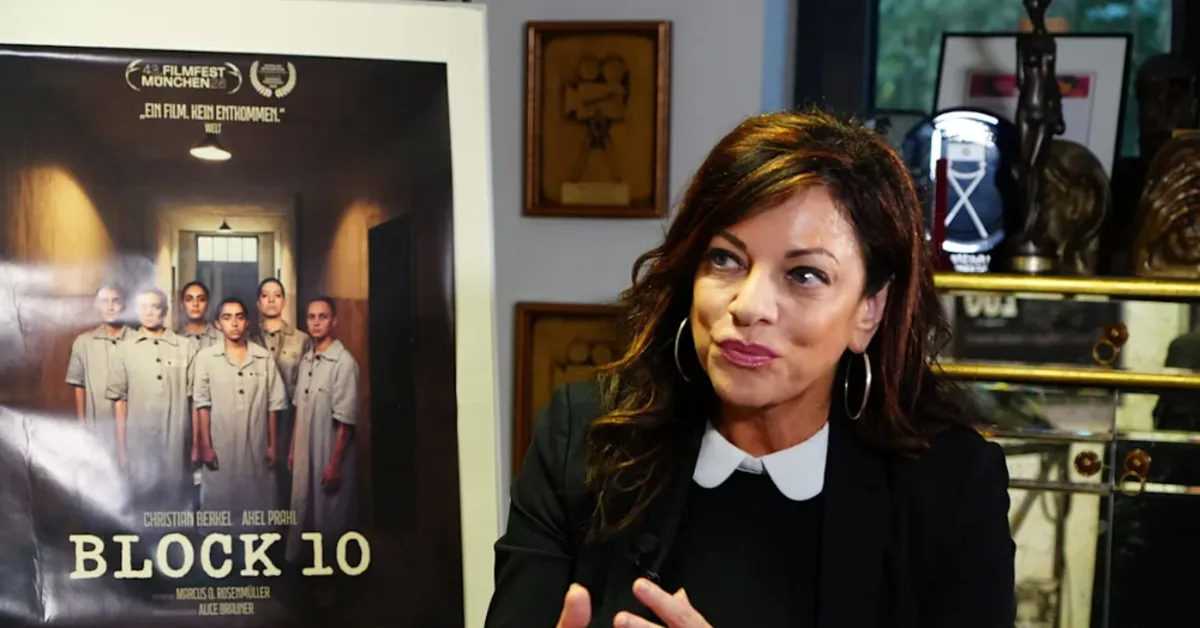

A new German feature film is bringing one of the least-known chapters of Auschwitz to cinema screens. Block 10 tells the story of hundreds of Jewish women and girls who were locked inside a sealed barrack and used in forced st*rilisation experiments. Directed by Marcus O. Rosenmüller and written and produced by historian Dr Alice Brauner, the film opened in selected German cinemas on 5 November 2026 with English subtitles. It has already won an audience award and had its international premiere at the Jewish International Film Festival in Australia.
Trigger warning: This article discusses Holocaust-era medical experiments and violence. Reader discretion is advised.
What Is ‘Block 10’ About?
The title refers to a real building complex inside the Auschwitz main camp. In early 1943, the SS confined several hundred Jewish women and girls inside Block 10, a sealed area cut off from the rest of the camp. The women had no daylight and very little space. Nazi doctors used them as test subjects for medical experiments, mainly forced st*rilisation.
At the centre of the film is Dr Maximilian Samuel, a Jewish gynaecologist from Cologne. He is deported to Auschwitz with his wife and daughter. The SS forces him to assist Dr Carl Clauberg, the Nazi doctor running the experiments. Samuel is blackmailed with his daughter’s life. If he refuses to cooperate, she will be killed. The film follows his moral conflict and the women who are trapped inside the block with him.
Christian Berkel plays Dr Maximilian Samuel. Axel Prahl plays Dr Carl Clauberg. Bibiana Beglau plays Dr Adélaïde Hautval, a French prisoner-doctor who refused to take part in the experiments. The cast also includes Moritz Führmann, Johannes Zirner, Sarah Maria Sander, Katharina Dalichau, Luise Aschenbrenner, Lea Faßbender and Gonny Gaakeer.
The film does not build a traditional hero story. It shows the block as a closed system where prisoners, doctors and SS officers are pressed together. Brauner has described the film as an attempt to show the “grey zone” that survivor and writer Primo Levi wrote about, where victims were forced to make impossible choices under threat.
Who Is in the Cast?
Christian Berkel leads the film as the prisoner-doctor Dr Maximilian Samuel. Berkel is known to international audiences for films such as Downfall and The Experiment, and for the series Hijack.
Axel Prahl plays Dr Carl Clauberg, the Nazi gynaecologist who ran the st*rilisation experiments. Prahl is one of Germany’s best-known television actors, mainly for his long-running role in the Münster Tatort crime series.
Bibiana Beglau plays Dr Adélaïde Hautval, the French doctor who refused to assist with the experiments. Hautval was later named Righteous Among the Nations by Yad Vashem in 1965.
Johannes Zirner plays Dr Horst Schumann, another SS doctor who carried out experiments at Auschwitz. Moritz Führmann, Sarah Maria Sander, Katharina Dalichau, Marta Sroka and Rafael Stachowiak are also in the ensemble.
The Real History Behind Block 10
The Auschwitz Museum records that between 150 and 400 Jewish women were held in two upstairs rooms in Block 10 at a time. They came from several countries, including Belgium, France, Greece, Hungary and the Netherlands. The block was put at Clauberg’s disposal in April 1943.
Clauberg wanted to find a fast, non-surgical way to st*rilise large numbers of women. Under the pretext of a gynaecological examination, he introduced a chemical irritant into the women’s reproductive organs. The chemical caused severe inflammation. In some cases, the fallopian tubes became blocked. X-rays were used to check the results.
The procedures were brutal. The Auschwitz Museum notes that complications included peritonitis, bleeding and sepsis. Some women died from the experiments. Others were killed so that autopsies could be carried out.
Dr Horst Schumann also used X-rays in st*rilisation experiments at Auschwitz. The film includes his character because the block was not the work of one doctor alone. It was part of a wider system of medical abuse inside the camp.
The real Dr Maximilian Samuel was a respected gynaecologist in Cologne before the war. He was deported to Auschwitz with his family. As a prisoner-doctor, he was forced to take part in experiments in Block 10. Historical records show that he did not survive the Holocaust.
Dr Adélaïde Hautval was sent to Auschwitz in January 1943 after she publicly defended Jewish prisoners in occupied France. She was transferred to Block 10 and ordered to help with medical experiments. She refused. Yad Vashem records that she told Dr Eduard Wirths that no person had the right to decide the fate of another. She survived the war and later testified in court about the experiments.
Block 10 was dissolved in 1944. The women were moved to other parts of the camp system, and some were sent to Ravensbrück, where experiments continued.
How the Film Was Made
Filming began in September 2025 at the CCC film studios in Berlin. A detailed reconstruction of Block 10 was built, including dormitory rooms and operating rooms. The production designer worked from 3D graphics of the original building.
The Auschwitz Museum allowed the filmmakers to use its new virtual film location project, called Picture from Auschwitz. The project uses 3D scanning to create a digital 1:1 representation of the Auschwitz I site. Block 10 is the first feature film to use the material. Exterior shots in the film come from this virtual reconstruction.
The arrival of prisoners was filmed at the Bochum Railway Museum with hundreds of extras. The film uses no musical score. The only music comes during the end credits, when a Jewish prayer for the victims of the Shoah is heard.
Actresses shaved their heads for the film, some of them in front of a running camera. An intimacy coordinator worked on the scenes involving nudity and supported the cast. Brauner has said that a psychologist was effectively present on set through that role.
The film also avoids showing naked bodies in full. Violence is shown in a direct, sober way. Brauner has said the aim was to keep the dignity of the victims in focus rather than turn their suffering into spectacle.
Premiere, Awards and Release Details
Block 10 had its world premiere at the Munich Film Festival on 3 July 2026. The screening was attended by Auschwitz survivor Eva Umlauf, who spoke to the Auschwitz Museum after watching the film.
“It was very realistic. I wish many people could see it. Very many, because there are those who disbelieve it. They do not believe what happened there.”
— Eva Umlauf, Auschwitz survivor
The film later won the Rheingold Audience Award 2026 at the Festival of German Films in Ludwigshafen. The festival is the second-largest audience film festival in Germany after the Berlinale.
Block 10 opened in selected German cinemas on 5 November 2026. The film runs 103 minutes and has an FSK 16 rating in Germany. It is in German, Ladino and Polish, with English subtitles available for the German release.
The film’s international premiere took place at the Jewish International Film Festival in Australia. The festival runs from 18 October to 26 November 2026 across Melbourne, Sydney and Perth. Sessions are preceded by a video introduction from Dr Simon Holloway of the Melbourne Holocaust Museum.
Atlas International Film is handling international sales. A release date for the United States, United Kingdom, Canada or India has not been announced.
What the Director and Producer Say
Director Marcus O. Rosenmüller has said that making the film was the hardest challenge of his career.
“For me as a director, it was the greatest challenge I have faced since I began making films. But I felt that this film was worth making. We tried, with the greatest respect and humanity, to show what was inhuman.”
— Marcus O. Rosenmüller
Producer and screenwriter Alice Brauner based the script on witness statements and court records. She has said that the details in the film are closely tied to the historical record.
“Every prisoner number is accurate, every person really existed.”
— Alice Brauner
Brauner also explained why she chose to make a feature film instead of a documentary. The Nazis destroyed most of the documents connected to Block 10, and very little film material survives. She has said that a feature film was the only way to bring the story to a wider audience.
What Critics and Audiences Have Said
German critics have described the film as difficult to watch but necessary. Weser-Kurier called it one of the most direct and disturbing films about the crimes of the Nazi era. The review noted that the film does not offer moments of hope because the women in Block 10 were given none.
Telepolis wrote that the story of Block 10 shows that Auschwitz contained more horror than many people know, beyond the mass murder of over one million people. The review pointed out that Josef Mengele was only one of many doctors involved in crimes at the camp.
Morgenpost described the film as “important” and “painful” and said that every event shown is based on survivor documents, witness statements and court records.
You May Also Like




The film’s German release has also brought the story of Block 10 to viewers who had never heard of the building before. Brauner has recommended watching the film with other people and talking about it afterwards. She hopes younger audiences will see it and engage with the history.
Block 10 runs 103 minutes and is rated FSK 16 in Germany. A companion book by Alice Brauner and Heike Gronemeier explores the historical background of the film.
Also Read: Naza Review: No Other Land Filmmakers Expose Israel’s Gaza Killing System in New Venice Documentary
Stay with VvipTimes for clear, fact-checked entertainment news and film release updates.

























Leave a Reply