

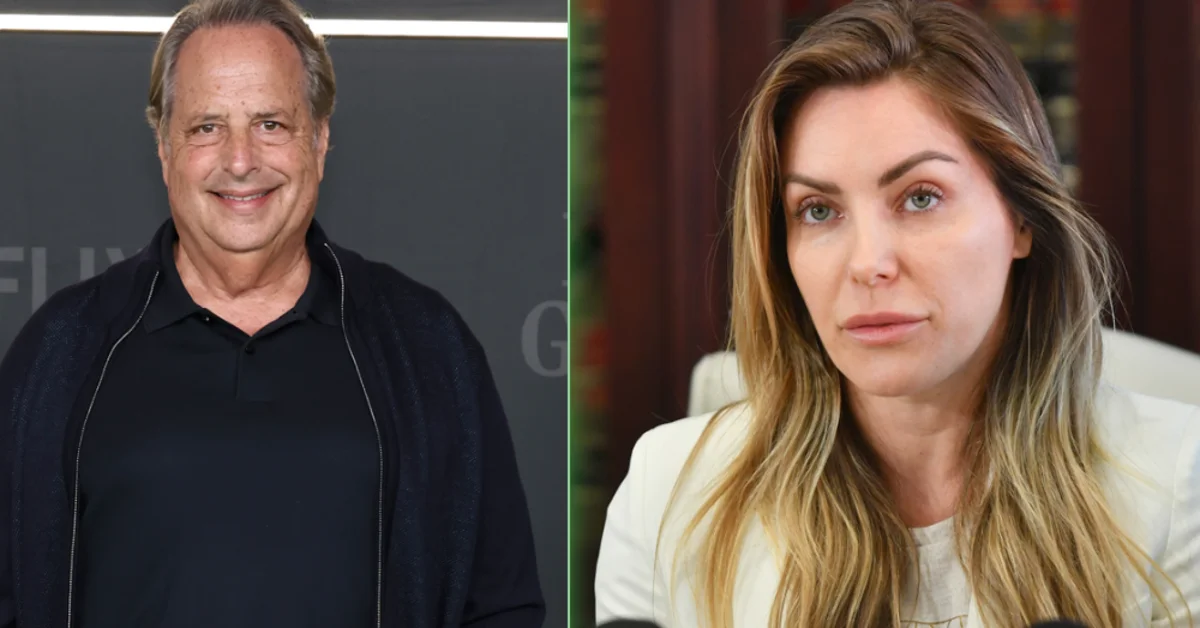

Crystal Hefner, the widow of Playboy founder Hugh Hefner, has publicly named comedian Jon Lovitz as “one of the biggest pervs” to frequent the Playboy Mansion, claiming he was the estate’s “No. 1 customer” and a constant presence at its notorious parties. The allegation, made during the Tuesday, October 27, 2026, episode of the Lisa Guerrero Unleashed podcast, immediately drew a response from the 69-year-old Saturday Night Live alum, who declined to engage directly with the substance of the claim while offering a pointed remark of his own. The exchange marks the sharpest escalation yet in a public feud that originated during the summer of 2026, when Lovitz criticized Hefner’s online reflections on her marriage.
The Podcast Allegation: “Every Time, Every Party”
During her appearance on the Unleashed podcast, Hefner, 40, described Lovitz as a fixture at the Playboy Mansion during its heyday, characterizing his behavior in blunt terms. “Jon Lovitz, you were Playboy Mansion’s No. 1 customer,” she said. “You were, like, one of the biggest pervs there”. She elaborated on what she observed: “His eyes would go front to back, all the women that walked through the door. And at the parties, he’d be the lurker. And I remember him every time, every party”. Hefner also mentioned that Lovitz had a dog that “peed all over the place” during his visits.
The allegation did not emerge in isolation. Hefner framed it as a direct response to Lovitz’s prior public commentary on her life, telling the podcast that Lovitz had been “completely attacked” by women in her Instagram comments after he questioned her motives for speaking out.
Jon Lovitz’s Response: Deflection and Defense
Lovitz addressed the claim on Tuesday evening in a video obtained by Page Six, choosing a tone that mixed humor with a refusal to litigate the specifics. “Any time someone says I’m No. 1, it’s a compliment,” he told the camera. He then pivoted to a defense of Hugh Hefner: “Hugh Hefner was one of the nicest, most generous people I’ve ever met, and all of his friends know it. That’s all I have to say about that”.
The response was strategically minimal. Lovitz did not deny Hefner’s characterization of his behavior, nor did he threaten legal action. Instead, he reframed the exchange around his loyalty to the late Playboy founder, a man he counted as a friend and whose 2012 wedding to Crystal he attended. Entertainment Weekly noted that representatives for Lovitz did not provide further comment when reached.
The July 2026 Instagram Feud: The Feud’s Origin Point
The public hostility between Hefner and Lovitz traces directly to July 2026, when Hefner posted a nearly two-minute video on Instagram expressing profound regret over her marriage to Hugh Hefner. “I regret the years I spent making myself smaller so his world could feel bigger,” she said in the post. “I regret learning to stay quiet when I could have spoken. I regret the version of myself that I had to abandon just to survive in that environment”.
Lovitz responded in the comments section with a series of pointed questions that framed Hefner’s retrospective as ingratitude. “Do you regret the house he bought for you to live in, after his death? And keeping the money, after you sold it?” he wrote. “And all the times your mother was at the mansion? And do you regret all he did for you? And do you regret leaving him and then coming back to marry him?”. The comment referenced the reported $5 million Hefner received upon Hugh’s death and a Hollywood Hills property Hefner later sold for a similar sum.
Hefner told the Daily Mail at the time that Lovitz’s response was “disappointing,” arguing that it reflected a broader cultural impulse to silence women who speak honestly about powerful men. “People often reduce my marriage to assumptions about financial benefit, but that overlooks the reality of what I experienced,” she said. “For years, there was an expectation that women should stay quiet to protect powerful men or preserve a certain image. I’m simply no longer willing to do that”.
Crystal Hefner’s Broader Allegations: A Widow’s Reckoning
The Lovitz allegation arrives amid a wider public reckoning by Hefner regarding her time inside the Playboy ecosystem. Her 2024 memoir, Only Say Good Things: Surviving Playboy and Finding Myself, detailed an environment of control and pressure, including claims that Hugh Hefner dictated her appearance, weight, and curfew. In the same Unleashed podcast episode that featured the Lovitz allegation, Hefner leveled far graver accusations against her late husband, alleging non-consensual sexual encounters, forced use of unclean sex toys, and an incident in which Hugh attempted to coerce twins Kristina and Karissa Shannon into incestuous acts. When host Lisa Guerrero suggested that one described incident “sounds like rape,” Hefner agreed.
Hefner has also claimed that Hugh Hefner’s scrapbooks may contain non-consensual explicit images of women and potentially underage girls, and she publicly asked actress Jessica Biel to reconsider her role as Hugh Hefner’s wife in the forthcoming Playmates film. These broader allegations provide essential context for the Lovitz claim: Hefner is not merely settling a social media score but advancing a sustained critique of the Playboy Mansion’s culture and the men who participated in it.
Who Is Jon Lovitz? A Career Built on Comedy and Controversy
Jon Lovitz, born in 1957, rose to national prominence as a cast member on Saturday Night Live from 1985 to 1990, earning two Primetime Emmy nominations during his tenure. He became known for characters including Tommy Flanagan of Pathological Liars Anonymous, Master Thespian, Hanukkah Harry, and the Devil. His film credits include A League of Their Own and Happy Gilmore, and he has maintained a steady career in stand-up, voiceover work, and character acting.
In recent years, Lovitz has become a vocal supporter of Donald Trump, a political shift he has attributed to the Democratic Party’s criticisms of Israel following the October 7 attacks. He has praised Trump’s policies on Israel and government spending, positioning himself outside the prevailing political alignment of much of the entertainment industry. This political identity adds a layer of friction to the dispute: Lovitz’s public persona as a Trump-aligned comedian who defends Hugh Hefner sits in direct opposition to Hefner’s role as a #MeToo-era voice challenging the legacy of a media mogul.
The Playboy Corporate Reality: A Licensing Company, Not a Mansion
While the public conversation centers on the Playboy Mansion’s social history, the corporate entity behind the brand has undergone a fundamental transformation. Playboy, Inc. (NASDAQ: PLBY), formerly known as PLBY Group, changed its name in June 2025 and now operates as a pleasure and leisure company with two primary segments: direct-to-consumer and licensing. The company’s revenue for the second quarter of 2026 reached $31.2 million, an 11% year-over-year increase, driven largely by its Honey Birdette retail segment and licensing operations. Licensing revenue alone was $11.2 million in Q2 2026, and the company reports more than $320 million in unrecognized future licensing revenue, with approximately 91% of fiscal year 2026 licensing revenue supported by contractual guarantees.
This financial reality is crucial for understanding the stakes of the Hefner-Lovitz dispute. The Playboy brand no longer derives its value from the mansion’s parties or the social capital of its famous guests; it monetizes trademarks, the Rabbit Head design, and lifestyle licensing deals across apparel, sexual wellness, and hospitality. Controversies involving the mansion’s historical culture carry reputational risk for a company that has spent years repositioning itself as a modern lifestyle and wellness brand. However, the licensing model’s reliance on contractual guarantees provides a degree of insulation from short-term public relations flare-ups.
Industry Impact: The Mansion’s Cultural Ledger and the #MeToo Reckoning
The Hefner-Lovitz exchange lands at the intersection of two ongoing cultural conversations. The first is the continued re-evaluation of Hugh Hefner’s legacy in the post-#MeToo era. Hefner died in 2017 at age 91, and for decades the Playboy Mansion functioned as a symbol of a particular kind of Hollywood power: a space where celebrity, sexual access, and institutional protection converged. The guest lists were legendary, encompassing figures from Jack Nicholson and Warren Beatty to Leonardo DiCaprio and Rihanna, alongside athletes, musicians, and business leaders. That social architecture depended on a supply of young women and a culture of tacit permission—elements that Hefner’s allegations now subject to direct scrutiny.
The second conversation concerns the accountability of the famous men who participated in that ecosystem. Hefner’s allegation against Lovitz is, on its surface, a claim about voyeurism and social behavior rather than criminal conduct. But in the current cultural framework, the distinction between “perv” as a colloquial insult and “perv” as a marker of complicity in a coercive environment is not a trivial one. By naming Lovitz as the mansion’s “No. 1 customer,” Hefner is not accusing him of a crime; she is assigning him a role in a system she describes as exploitative. Lovitz’s response—a joke followed by a defense of Hugh Hefner’s generosity—does not contest that role. It simply declines to treat it as a serious matter.
The lack of formal industry consequences for Lovitz is itself notable. No studio or network has announced a review of his projects, and no corporate partner has issued a statement. The dispute remains confined to the realm of podcast appearances, tabloid reporting, and social media commentary—a pattern consistent with the broader post-#MeToo landscape, in which allegations that do not meet a certain threshold of specificity or criminality often produce reputational friction without institutional rupture.
Public and Fan Reaction: A Divided Digital Response
Public reaction to the exchange has been sharply divided along predictable cultural lines. Hefner’s supporters on social media framed her allegation as a long-overdue naming of a man who benefited from an environment she has described as abusive; the phrase “No. 1 customer” circulated widely as a shorthand for his alleged role. Lovitz’s defenders, meanwhile, focused on his charitable and professional record, arguing that a podcast characterization from a woman with a public grievance does not constitute proof of misconduct. The Daily Beast characterized Lovitz’s response as “smug,” while Entertainment Weekly noted that he “doesn’t seem too pressed” by the claim.
The lack of a unified consensus reflects a broader pattern in celebrity accountability disputes: audiences increasingly interpret allegations through pre-existing political and cultural affiliations. Lovitz’s Trump support and Hefner’s role as a #MeToo-era memoirist map neatly onto opposing sides of a cultural divide, and the reaction to the dispute has largely tracked those allegiances rather than the specific facts of the allegation itself.
Next: Legal, Professional, and Brand Considerations
The dispute carries several potential pathways forward. Legally, Hefner’s characterization of Lovitz as a “perv” and a “lurker” could, in theory, invite a defamation claim, but the context—a podcast interview about personal memories of a semi-public social environment—would make such a claim difficult to sustain, particularly given the colloquial nature of the language. Lovitz has shown no indication of pursuing legal action, and his response suggests a preference for de-escalation through humor and deflection.
Professionally, the dispute is unlikely to alter Lovitz’s standing in the comedy and character-acting market. His career has weathered political controversy before, and his fan base is largely concentrated among audiences that are not primarily motivated by Playboy Mansion discourse. For Hefner, the podcast appearance forms part of a broader promotional and testimonial arc that includes her memoir and her public advocacy regarding the Playboy legacy. The Lovitz allegation extends that arc into a new celebrity target, but it does not fundamentally change the narrative she has been building since 2024.
You May Also Like:



View all articles about
For Playboy, Inc., the dispute represents a manageable reputational event. The company’s licensing-driven revenue model, with its heavy reliance on contractual guarantees, provides a buffer against short-term cultural controversies. The brand’s long-term value depends on its ability to remain culturally relevant without being consumed by its own history—a balancing act that the Hefner-Lovitz exchange makes more difficult, but not impossible.
Also Read: Love Is Blind Aneha Wants a Provider: Inside the Salary Gap
VVIPTimes will continue tracking the fallout from Crystal Hefner’s allegations and Jon Lovitz’s response as the story develops.





















Leave a Reply