


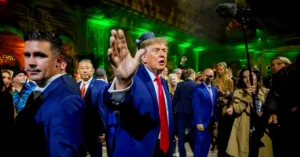
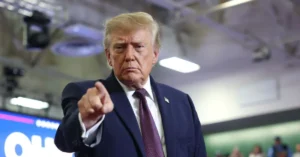
Donald Trump told a crowd in Dubuque, Iowa, on November 1, 2026, that he could have won the Vietnam War in just seven days. The president also said the only reason the conflict with Iran is not finished is that he wants to be “nice” and save lives. The remarks came during a midterm election rally at the Five Flags Center, two days before the November 3 midterm elections.
Trump compared the long Vietnam War to the shorter Iran conflict. He criticized past presidents for bombing forests with Agent Orange for years instead of striking Ho Chi Minh City directly. “I would’ve won the Vietnam war in a week,” Trump said at the rally. The statement quickly drew criticism online and from political analysts, who pointed out a major factual error in his strategy.
Trump Criticizes Past Vietnam Strategy at Iowa Rally
At the rally, Trump focused on how previous administrations handled the Vietnam War. He said the United States wasted years dropping chemicals on forests instead of hitting key cities. “They dropped whatever that red cr*p is and they kept dropping it in the forest. Agent Orange, they dropped it in the forest for years and years and years. Instead of going after Ho Chi Minh City and different places,” Trump told the crowd.
The president argued that this approach was a mistake. He claimed that targeting Ho Chi Minh City would have ended the war quickly. Trump also said he could have won the war in Afghanistan in a short time as well. He used the speech to draw a contrast between the long Vietnam War and the current conflict with Iran. “We were in Vietnam for 18 years, in Iraq for years. In Iran for only six weeks,” Trump said in earlier remarks about the same comparison.
The White House has not released a formal statement explaining the military strategy Trump described. The rally was part of a campaign push for Rep. Ashley Hinson, who is running for the Senate against Democrat Josh Turek.
‘The Only Reason I’m Not Finished With Iran Is I Want to Be Nice’
Trump connected the Vietnam comments directly to the ongoing conflict with Iran. He said the United States could finish the fight quickly but he has chosen to hold back. “The only reason why I’m not finished with Iran is I want to be nice. I want to try and save all those lives if I can,” Trump said. He then added a warning: “But at some point we’re going to have to give them the hammer”.
The president did not say when this “hammer” would come or what it would involve. The comments repeat a threat he has made before. In September 2026, Trump called the Iran conflict “small potatoes” and compared the 18 U.S. service members killed in Iran to the tens of thousands who died in Vietnam. At the Iowa rally, he again brought up the death toll difference. “We lost 18 great souls. But in Vietnam, we lost tens of thousands of people,” he said.
Trump’s “nice” remark is the part of the speech that has traveled furthest on social media. Critics noted that calling a decision to continue a military conflict an act of kindness is unusual. The president framed it as a choice between saving lives and using greater force. He did not explain what has stopped him from using that greater force already.
Factual Error: Ho Chi Minh City Was Saigon, Then a U.S. Ally
The biggest problem with Trump’s Vietnam claim is historical. Ho Chi Minh City was not called that during the war. The city was known as Saigon, and it was the capital of South Vietnam, which was an ally of the United States. The enemy capital was Hanoi, in North Vietnam. The U.S. had already bombed North Vietnam heavily during Operation Rolling Thunder from 1965 to 1968.
Critics pointed out that bombing Saigon would have meant bombing an allied city, not an enemy stronghold. “He wanted to bomb the headquarters of South Vietnam??? I mean in a way that would have ended the war in a week I guess,” one social media user wrote. Another user said, “You do realise that Ho Chi Minh City back then was Saigon and was governed by South Vietnam, right, and even US troops were there. So while it’s good that you spared Hanoi (maybe), you decided to bomb the thing you have created”.
The city was renamed Ho Chi Minh City in 1976, after the war ended and the country was unified under communist rule. Trump’s use of the modern name for a wartime strategy suggests he was not describing a plan that would have made sense at the time.
Trump’s Own Draft History Enters the Conversation
Social media reactions quickly brought up Trump’s own record during the Vietnam era. The president did not serve in Vietnam. He received five draft deferments during the war, including four educational deferments and a medical exemption for bone spurs in his heels in 1968.
Alex Cole, a liberal news creator, posted on X: “Draft dodger Trump couldn’t defeat algae in a swimming pool, but he was going to conquer the jungles of Vietnam in a week”. The line was shared widely. Trump’s bone spurs diagnosis has been questioned before. In 2016, he told The New York Times that the bone spurs were “not a big problem” but were “difficult from the long-term walking standpoint”.
The contrast between Trump’s claim that he could have won the war and his own avoidance of service is the center of the online criticism. The president has not responded to those specific reactions. The White House did not issue a statement about the deferments after the rally.
Analysts Point to Afghanistan Record as a Counterexample
Political analysts also challenged Trump’s claim that he could have won Afghanistan quickly. Gregory Brew, an Iranian oil analyst for the Eurasia Group, posted on X: “Throughout the entirety of Trump’s first term, the U.S. was at war in Afghanistan. Not only did he not win it, but his administration negotiated the deal that made the events of 2021 essentially unavoidable. This is a curious boast to make”.
Jonah Goldberg, editor-in-chief of The Dispatch, made a similar point. “He could have ‘won’ Afghanistan during his first term. But he spent most of it trying to get out,” Goldberg posted. Alex Ward, a national security reporter for The Wall Street Journal, said Trump’s deal with the Taliban during his first term set up the withdrawal from Afghanistan in 2021. “Trump oversaw four years of the war in Afghanistan, and made a deal with the Taliban—cutting out the Afghan government—that set the table for Biden’s disastrous withdrawal,” Ward posted.
These reactions focus on a pattern: Trump claims he would have won wars quickly, but he had the chance to end one of those wars during his own presidency and did not do so. The Afghanistan war lasted from 2001 to 2021, spanning four presidencies. Trump’s deal with the Taliban was signed in February 2020, and the withdrawal was completed under President Joe Biden in August 2021.
The Vietnam War Numbers Behind the Claim
The Vietnam War ran from November 1955 to April 1975. It lasted nearly 20 years, not the one week Trump says he would have needed. A total of 58,279 U.S. service members died in the conflict, according to the Department of Veterans Affairs. Around 300,000 were wounded, and 153,000 required hospital care.
Trump’s comparison between Vietnam and Iran relies on these numbers. The Iran conflict has killed 18 U.S. service members so far, a much smaller figure. The president uses that difference to argue that his approach is working and that he is being careful with American lives. But the comparison also highlights the scale of the Vietnam War, which makes his one-week claim seem unrealistic to military historians.
The war ended with the fall of Saigon in April 1975. North Vietnamese forces took the city, and the United States had already withdrawn its combat troops in 1973. The outcome was not a U.S. victory. Trump’s claim that he could have changed that outcome in seven days ignores the political and military realities that shaped the conflict.
What Trump Said About Iran and the ‘Hammer’
The Iran portion of Trump’s speech is the part with the most direct news value. The president said he is holding back for a reason. “I want to try and save all those lives if I can,” he said. He then warned that the situation could change. “At some point we’re going to have to give them the hammer”.
Trump did not define what “the hammer” means. In past speeches, he has used similar language to suggest military strikes or economic pressure. The United States has been in a military conflict with Iran for several months. Trump has repeatedly said the U.S. is in a “very strong position” and that time is not on Iran’s side.
The president’s remarks come as his administration is trying to close a deal with Iran to end the conflict. He said at the rally that a deal is possible. “Either we reach an agreement or we don’t,” he said. The “nice” comment and the “hammer” threat are two sides of the same message: Trump wants to present himself as both a peacemaker and a leader willing to use force.
You May Also Like



View all articles about
Social Media Reaction Focuses on Irony and Accuracy
The online reaction to Trump’s speech has focused on two things: the historical error and the irony of his draft record. The Ho Chi Minh City mistake was the most shared point. Users pointed out that the city was an ally’s capital, not an enemy target. The draft deferment angle added a personal contrast that made the claim seem even bolder to critics.
The reactions also brought up Trump’s past claims about other wars. He has said he could have won the Iraq War quickly and that he could have ended the war in Ukraine in 24 hours. Those claims have not been tested. The Vietnam and Afghanistan claims are easier to check because those wars are over and the outcomes are known.
Supporters of the president at the rally did not focus on the historical details. The crowd cheered when Trump criticized past leaders and promised to protect American lives. The rally was a campaign event, and the audience was there to support Ashley Hinson and the Republican ticket. The Vietnam comments were part of a broader speech that covered immigration, the economy, and the midterm elections.
Also Read: Bachelor Alum Melissa Rycroft Arrested Again: Second DWI Charge Just Two Months After Guilty Plea
The Iowa rally was one of several events Trump has held ahead of the November 3 midterms. The president’s remarks about Vietnam and Iran are likely to keep circulating online because they combine two topics he talks about often: his own record as a leader and his criticism of past presidents.
For more coverage of the stories shaping the conversation, keep reading VvipTimes.
































Leave a Reply