

The first season of IT: Welcome to Derry has ended, but for viewers who waited through the final credits, a crucial piece of the puzzle was waiting. The post-credits scene jumps forward to October 1988, directly connecting the prequel’s story to the traumatic past of one of the Losers’ Club’s most central members: Beverly Marsh.
The brief but loaded scene answers a long-standing question from IT Chapter Two and rewrites a tragic part of Beverly’s history. It reveals the identity of a mysterious old woman and shows a devastating moment that would haunt Beverly for decades.
Who Is the Old Woman in the Post-Credits Scene?
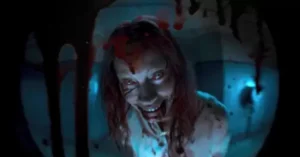
The elderly woman seen in the Juniper Hill Asylum is Ingrid Kersh, played by actress Joan Gregson. This is the same actress who portrayed the terrifying Mrs. Kersh who torments the adult Beverly Marsh, played by Jessica Chastain, in the 2019 film IT Chapter Two.
In Welcome to Derry, viewers first meet a younger Ingrid, played by Madeleine Stowe, in the 1960s timeline. She is revealed to be the daughter of Bob Gray, the real circus performer whose identity was stolen by the ancient evil entity that becomes Pennywise the Dancing Clown. After a devastating encounter with Pennywise’s Deadlights, Ingrid loses her sanity and is committed to the Juniper Hill Asylum, where she remains for decades.
The post-credits scene shows her there in 1988, now an elderly patient. Joan Gregson, at 91 years old, reprised the role for this scene. This was her final acting role before she passed away in June 2025, just two months after filming.
The Tragic Death of Elfrida Marsh
The commotion that draws Mrs. Kersh from her room is a suicide. The staff is dealing with the death of a patient named Elfrida Marsh.
For fans of the IT story, that name is significant. Elfrida Marsh is Beverly Marsh’s mother. In the post-credits scene, a teenage Beverly, played once again by Sophia Lillis, is shown grieving over her mother’s body alongside her father. A nurse’s comment, “This time she’s really dead,” hints that Elfrida had attempted suicide before.
This changes a key detail from Stephen King’s original novel. In the book, Beverly’s mother dies from cancer. The Welcome to Derry scene establishes a new, more immediate, and traumatic cause of death for the IT film universe, directly linking this family tragedy to the cursed town of Derry.
How This Scene Recontextualizes IT Chapter Two
The post-credits moment creates a direct bridge between the prequel and the 2019 sequel. It shows that the real Beverly Marsh and the real Ingrid Kersh met once before, on the worst day of young Beverly’s life.
As the grieving Beverly turns around, the elderly Mrs. Kersh offers her a disturbing, crooked smile and a piece of advice that sounds deeply ominous:
“Oh dear, don’t be sad. You know what they say about Derry? No one who dies here ever really dies.”
This line is verbatim what the manifestation of Mrs. Kersh says to the adult Beverly in IT Chapter Two. The connection reveals why Pennywise later chooses to take the form of this specific old woman to scare Beverly. The entity is tapping into a deeply buried, traumatic memory.
Jason Fuchs, a co-creator of Welcome to Derry, explained the choice: “It knows that Beverly actually met Mrs. Kersh at least once and it was on the worst day of her life, the day her mother committed suicide. So, when It takes that form, it’s also a way of tapping into a long buried memory.”
The scene confirms that the Mrs. Kersh who terrifies Beverly in 2016 is not the real woman but a form of Pennywise designed to exploit this childhood horror. The real Ingrid Kersh likely died long before 2016.
Fan Reactions and Speculation About the Scene
The post-credits scene has generated significant discussion among fans online. Many have expressed appreciation for the clever narrative link that deepens the lore of the films.
On social media, fans have also pointed out a potential earlier cameo. Some viewers believe that an unnamed redheaded teenager seen in Welcome to Derry’s second episode, who slips a love note into a locker, might be a young Elfrida Marsh. The character’s resemblance to Beverly and her action with the note—mirroring Beverly’s cherished anonymous letter from Ben Hanscom—has led to this theory.
The scene also raises larger questions about Pennywise’s influence. The date, October 1988, is key. It is the same month the entity awakens and kills Georgie Denbrough, beginning its new cycle of fear. Some fans speculate whether the dark atmosphere of Derry during this active cycle could have contributed to or influenced Elfrida Marsh’s tragic decision.
You May Also Like:




The Future of Welcome to Derry and Its Timeline
The creators of Welcome to Derry, Andy and Barbara Muschietti, have stated plans for the series to move backwards in time. They have confirmed their intent for a potential second season to be set in 1935, exploring the previous 27-year cycle of Pennywise’s awakening.
However, the post-credits scene proves the series is also willing to jump forward. It solidifies that Pennywise’s story is not linear. The entity experiences past, present, and future simultaneously. This idea was hinted at in the season finale when Pennywise revealed knowledge of future events, such as the existence of Richie Tozier.
This approach allows the prequel to create genuine stakes, even though audiences know Pennywise survives to the 1980s. By showing that the entity can perceive and potentially influence events across different eras, the threat it poses becomes more complex and dangerous.
Also Read: Castle Rock Season 1 Cast And Characters Explained: Who’s Who In Stephen King’s Hulu Horror