

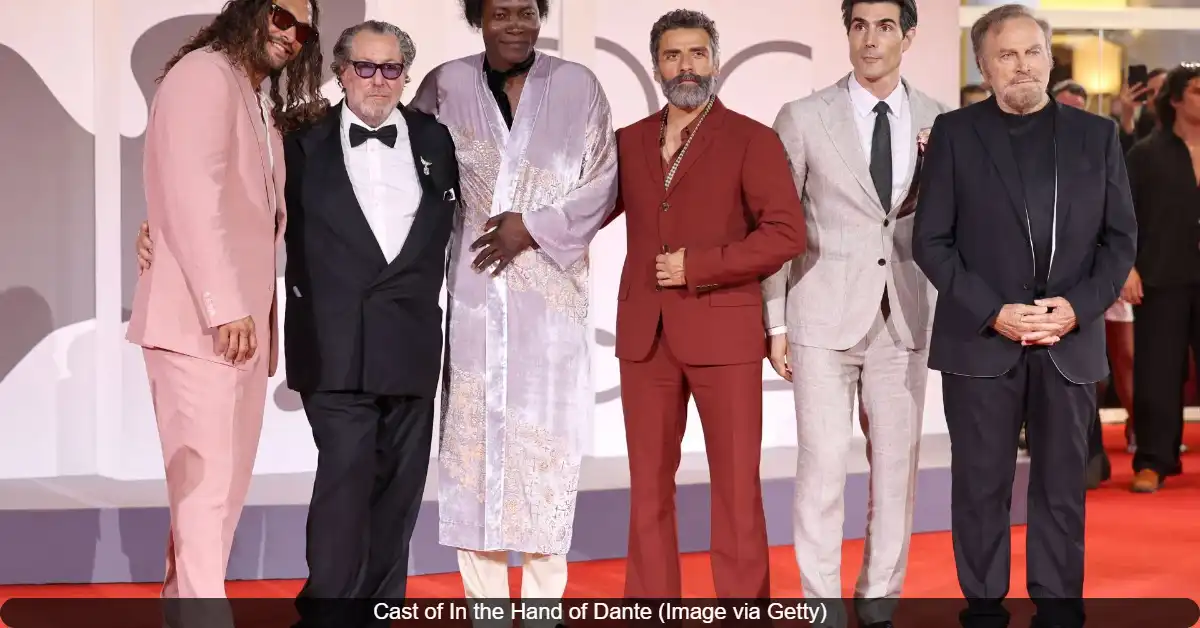
The theory that The Hand of Dante‘s two timelines literally converge in the ending is understandable, but the film itself doesn’t fully support that reading. In fact, the ending works better if you see the convergence as thematic rather than physical or metaphysical.
The film never confirms the timelines become one
Throughout the movie, Julian Schnabel deliberately cuts between:
- Medieval Dante Alighieri‘s life.
- Modern writer Nick Tosches‘ hunt for the manuscript.
The editing becomes increasingly parallel near the end, but parallel editing isn’t the same as narrative convergence. It’s a filmmaking technique that invites comparison rather than proving two realities merge.
The manuscript replaces the mystery
By the final act, the manuscript stops functioning as the plot’s ultimate prize. Instead, it becomes a symbol of artistic legacy and personal transformation.
If the film intended an actual merging of timelines, you would expect some concrete payoff:
- a clear supernatural event,
- characters acknowledging impossible knowledge,
- or historical and modern events directly affecting each other.
None of those happen. The ending remains intentionally ambiguous.
Nick’s journey is psychological
One popular interpretation is that Nick Tosches gradually becomes spiritually aligned with Dante Alighieri.
That’s different from becoming Dante—or existing in the same timeline.
The film repeatedly suggests that studying a great artist changes the person doing the studying. Nick’s transformation is internal, not necessarily supernatural.
The visual language encourages overreading
The closing montage intercuts Dante Alighieri finishing his life’s work with Nick Tosches reaching emotional clarity.
Many viewers interpret this as the timelines finally “meeting.”
But nothing in the narrative establishes rules that would allow time itself to collapse. Instead, the montage suggests both men are experiencing similar emotional and spiritual resolutions centuries apart.
That’s a much more conventional use of parallel storytelling.
The ending prioritizes symbolism over plot mechanics
The film is much more interested in ideas like:
- how art survives its creator,
- the relationship between faith and obsession,
- whether a masterpiece can transform future generations.
Those themes don’t require literal timeline convergence. In fact, making the convergence explicit might weaken the symbolism by turning metaphor into plot.
Related:
Why the theory feels unsatisfying
If someone spent the film expecting the dual timelines to culminate in a tangible reveal—such as Nick Tosches literally becoming Dante Alighieri, reincarnation being confirmed, or history folding into the present—the ending can feel like it promises more than it delivers.
Instead, the film stops short of confirming any of those possibilities. It leaves viewers with symbolic echoes rather than definitive answers, which is why many people feel the ending doesn’t fully justify the “timeline convergence” theory. The evidence supports resonance between the two stories far more strongly than an actual fusion of timelines.
Readers discussing The Hand of Dante in June 2026 continue to debate whether the film’s ending is meant to be interpreted literally or purely as a symbolic connection between its two narratives.




























Leave a Reply