


Netflix has released all eight episodes of Monster: The Lizzie Borden Story, the fourth chapter of Ryan Murphy and Ian Brennan‘s true-crime anthology. The series dramatizes the 1892 ax murders of Andrew and Abby Borden in Fall River, Massachusetts, and the sensational trial that ended with their daughter Lizzie Borden walking free. Starring Ella Beatty in her first major lead role, the season explores the grim details of the killings, the evidence that failed to convict, and the strange life Lizzie built after the verdict.
The Morning That Ended Two Lives
August 4, 1892, began as an ordinary summer day at 92 Second Street. The Borden household woke early. Bridget “Maggie” Sullivan, the family’s live-in maid, started her chores. John Morse, a relative who had spent the night, joined Andrew and Abby for breakfast before leaving before 9 a.m. Emma Borden, Lizzie’s older sister, was away in Fairhaven, leaving Lizzie and the maid at home during the most critical hours.
Andrew, a wealthy and well-known businessman, left the house shortly after breakfast to run errands downtown. Abby went upstairs to prepare the guest room where Morse had slept. Investigators later estimated that Abby was attacked around 9:30 a.m., receiving approximately 18 or 19 blows to her head. Bridget was outside washing windows and said she heard nothing unusual. Lizzie, however, remained inside the house. That detail became central to the case against her.
Andrew returned home between 10:40 and 10:45 a.m. and was let in by Bridget. Lizzie told the maid that Abby had gone to visit a sick friend after receiving a note, but no such note was ever found. Andrew settled onto the sofa in the downstairs sitting room. Around 11 a.m., he was attacked with roughly 10 or 11 blows to his head and face. About ten minutes later, Lizzie called Bridget and told her that someone had killed their father. Neighbors arrived quickly, and police were notified. Andrew’s body lay downstairs. Abby’s body was found upstairs in the guest room.
Why Lizzie Borden Became the Prime Suspect
Lizzie’s accounts of her movements that morning were inconsistent. She gave different explanations about where she had been and claimed she heard nothing during the attacks despite being in the same house. Her behavior in the days before the murders also drew scrutiny. On August 3, the day before the killings, Lizzie tried to buy prussic acid from a local drugstore, saying she needed it to keep moths away from a fur cape. That attempt was later ruled inadmissible in court.
Three days after the deaths, Lizzie was seen burning a dress in the kitchen stove. Prosecutors suggested she was destroying evidence, possibly clothing stained with blood. A hatchet head was found in the basement, but tests showed no traces of blood, and investigators could not prove it was the murder weapon. The prosecution had motive, pointing to a possible inheritance, and opportunity, since Lizzie was home when both killings occurred. But without the weapon or any physical evidence directly linking her to the crime, the case rested on circumstance.
The Trial and the Verdict That Shocked the Nation
Lizzie Borden was arrested on August 11, 1892, one week after the murders. Her trial opened on June 5, 1893, at the New Bedford Courthouse. The courtroom became a national spectacle. The public was transfixed by the lurid details of the case, and Lizzie’s fate rested on whether the all-male jury believed a woman could commit such a brutal act.
On June 20, 1893, after just one hour of deliberation, the jury acquitted Lizzie Borden of both murders. The verdict shocked many, but the lack of a definitive weapon and the purely circumstantial nature of the evidence made a conviction difficult. Commentators later noted that the jury, composed entirely of men, would have struggled to accept that a woman from a respectable family could carry out such violence.
You May Also Like:















Life After the Acquittal: Maplecroft and the Shadow of Suspicion
The acquittal did not erase the suspicion that followed Lizzie Borden. She inherited a portion of her father’s estate and, weeks after the trial, bought a larger house on French Street called Maplecroft, where she lived with her sister Emma. Despite her legal freedom, the community never fully accepted her. The rhyme that had spread across the country, “Lizzie Borden took an ax, and gave her mother forty whacks,” ensured her name remained tied to the crime.
Lizzie lived at Maplecroft until her death in June 1927. Her sister Emma moved out years earlier, and the two reportedly had a falling out. The house on Second Street where the murders took place later became a bed-and-breakfast and museum, drawing tourists curious about the unsolved case.
A New Chapter for the Monster Anthology
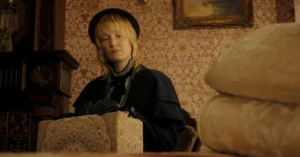
Monster: The Lizzie Borden Story marks the first season of the anthology to focus on a female subject. Previous seasons covered Jeffrey Dahmer, the Menendez brothers, and Ed Gein. Ella Beatty, the daughter of Annette Bening and Warren Beatty, plays Lizzie as a woman confined by Victorian expectations and pushed toward violence. She is joined by Vicky Krieps as the maid Bridget “Maggie” Sullivan, Charlie Hunnam as Andrew Borden, and Rebecca Hall as Abby Borden. Sarah Paulson appears as Aileen Wuornos, connecting Lizzie’s story to another infamous female killer nearly a century later.
The eight-episode season premiered on September 17, 2026, on Netflix. It dramatizes the murders, the trial, and the years that followed, offering a speculative look at what might have driven Lizzie Borden to kill, even as the legal system declared her innocent.
Also Read: Monster: The Lizzie Borden Story Redefines Ryan Murphy Anthology with Acquitted Female Lead
Stay tuned to VvipTimes for more in-depth coverage of the true stories behind your favorite shows.

























































































Leave a Reply