

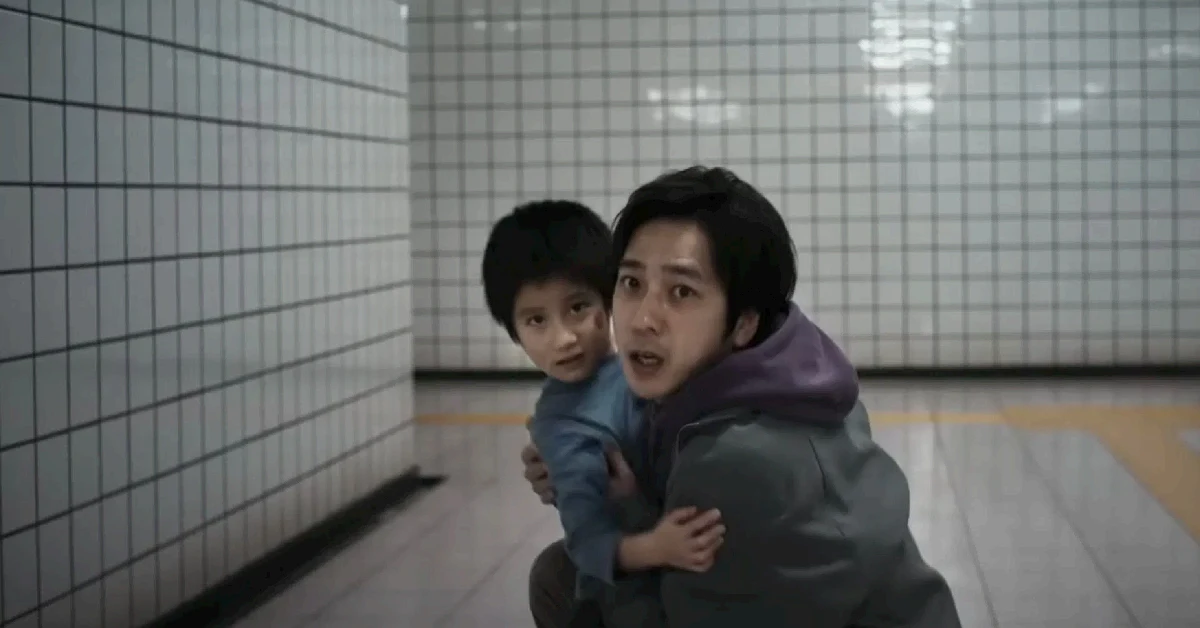

The new Japanese horror film Exit 8 hit theaters on April 10, 2026, and audiences are walking out with more questions than answers. The movie, based on the popular indie game by Kotake Create, traps viewers in a never-ending subway corridor alongside its main character. Director Genki Kawamura (known for producing Your Name) has created a psychological puzzle that refuses to give easy answers. This story follows a man stuck in a strange loop where small mistakes send him back to the start. But the real puzzle comes at the end. Did he actually escape? Or is freedom just another trick? Let’s break down what happens in Exit 8 and what it all means.
The movie opens with a simple scene that carries heavy weight. A man, played by Kazunari Ninomiya (famous for Letters from Iwo Jima), rides a subway train. He ignores a mother struggling with a crying baby while another passenger yells at her. He keeps his earphones in and looks away. After getting off the train, he receives a phone call from his ex-girlfriend. She tells him she is pregnant and asks what he wants to do. He cannot give her an answer. He promises to visit her at the hospital but hangs up feeling lost.
Right after this call, the man tries to leave through Exit 8. But something is wrong. The corridor looks the same no matter which way he walks. He passes the same signs, the same tiles, and the same mysterious man in a suit who walks past him every time. Soon, he finds a sign on the wall that explains the rules. The task sounds simple: look for anything strange or unusual, called anomalies. If you see an anomaly, turn back immediately. If everything looks normal, keep moving forward. Make the right choice eight times in a row, and you can leave through Exit 8. One wrong move, and the loop starts over from zero.
The Rules of the Subway Loop and the Anomalies
The Exit 8 movie follows the same basic rules as the video game, but the film adds a deeper emotional layer. The man must walk through the same white-tiled hallway again and again. Each round, he looks for something out of place. A poster might change. A door handle might move to the center instead of the side. The smiling walking man might appear right behind him instead of walking ahead. Blood might drip from the ceiling.
Each time the man spots an anomaly correctly, he turns around, and the exit number on the wall goes up by one. If he misses an anomaly or turns back when nothing is wrong, the number resets to zero. This repeating cycle becomes a test of observation and mental strength. The man starts taking pictures of everything with his phone to track changes. But even his photos get corrupted, showing him that nothing in this place can be trusted.
The film introduces two other lost souls in the same loop. There is the Walking Man (played by Yamato Kochi), a suited figure who appears to be stuck just like the main character. There is also a young boy (played by Naru Asanuma) who wanders the corridor alone. The movie shifts between their points of view, showing that multiple people are trapped in this strange subway purgatory. The Walking Man has his own struggles. He yells at the rules sign in anger, screaming that he was supposed to meet his son that day. The boy has a bruise on his cheek and does not speak much. He later admits that he ran away from his mother on purpose so she would look for him.
Director Genki Kawamura explained in an interview that he drew inspiration from Dante’s Divine Comedy and the idea of purgatory. He sees the subway corridor as a place where people must face their sins. “We all, living our daily lives, have some kind of sin,” Kawamura said. “We imagined, what if these people had to face their sins in this purgatory-like space?” The anomalies are not random scares. They represent the small wrongs people ignore every day, like looking away from someone in need or avoiding hard conversations.
What Happens When the Lost Man Finally Reaches Exit 8
After many loops and failures, the man finally reaches Exit 8 with the boy by his side. The corridor looks normal. No strange changes. No smiling figures. The exit sign glows ahead of him. He walks forward with the boy holding his hand. The movie does not show what is outside. There is no dramatic moment of freedom. No bright light or cheering crowds. The man simply walks toward the exit, and the screen cuts away.
This open ending has left many viewers wondering what really happened. Did the man escape? Or did the loop just reset one more time without him realizing it? The movie gives no clear answer on purpose. Genki Kawamura wants the audience to question what is real. The subway corridor represents the mental traps people build for themselves. The fear of becoming a father, the guilt of not standing up for others, the weight of past mistakes, all of these can create loops in a person’s mind that feel impossible to break.
The boy plays a key role in the final moments. Before they reach the exit, the boy gives the man a seashell for good luck. The man asks the boy what he wants to do when they get out. The boy simply says, “Get a pizza.” This small, normal wish stands out against all the horror and confusion of the loop. It suggests that freedom might not be about grand answers. It might be about simple things, like sharing a meal with someone you care about.
Does the Man Actually Escape or Is He Still Trapped
The ending of Exit 8 works on two levels. On the surface, the man reaches the exit and walks out. The loop stops. He has made eight correct choices in a row. He learned to spot anomalies, which symbolizes learning to pay attention to the world around him and take responsibility. He stopped ignoring the mother with the baby. He faced his fear of becoming a father. He helped the lost boy. By the end, he is a different person than the man who put his earphones in and looked away.
But there is a darker reading of the ending. The exit itself could be an anomaly. The corridor has tricked the man before. Posters change. Doors move. People appear and disappear. Why should the exit be any different? Some viewers believe that the man never actually escapes. He simply enters another layer of the loop, one where freedom looks real but is just another illusion. This reading fits with the movie’s themes of anxiety and mental health. People who struggle with depression or obsessive thoughts often feel like they have escaped their problems, only to fall back into the same patterns later.
The director supports this open interpretation. “I was very adamant about not using CG for this movie,” Kawamura said. “We physically built two identical corridors. We wanted to make sure the edit points were blurred to the point where the audience couldn’t tell when a certain set ended and the other one began.” This physical trick mirrors the mental trick of the story. The line between escape and continued trapping is impossible to see clearly.
Critics have mixed feelings about the ending. JoBlo’s review praised the film’s creativity but noted that the emotional story loses momentum in the third act. IGN gave the film a mediocre rating, saying the movie fails to justify a feature-length runtime and that thinking too hard about the story’s meaning will likely ruin the experience. Other outlets like High on Films appreciated the deeper symbolism, calling the subway corridor a place where observation itself becomes a form of survival.
Related Stories




View all articles about
What the Subway Corridor Symbolizes in the Story
The endless subway in Exit 8 is more than just a scary setting. It represents the daily grind of modern life. Millions of people ride subways every day, packed together but completely alone, staring at their phones instead of looking at each other. Genki Kawamura pointed out this social problem in his interview. “You look at passengers on the train. There are all these people sharing this car, yet everyone is on their own smartphone,” he said.
The rules of the game also reflect how people deal with stress and fear. When something feels wrong, turn back. When everything seems normal, keep going. This sounds simple, but the movie shows how hard it is to trust your own judgment. After enough time in the loop, the man starts doubting everything. Even normal things begin to feel strange. This paranoia is how anxiety works in real life. Small worries grow into big fears, and eventually, a person cannot tell the difference between real problems and imagined ones.
The movie also carries a message about fatherhood and responsibility. The man runs away from the news of the pregnancy. He does not know if he can be a good father because he has never stood up for anyone before. The boy in the corridor serves as a mirror for his fears. By helping the boy escape, the man learns to accept the role of protector. Whether he actually makes it out of the subway or not, he has changed on the inside. Some critics found this message too direct. The JoBlo review noted that the film stops being a tense mystery and starts feeling wildly moralistic by the third act.
Exit 8 opened in theaters on April 10, 2026, distributed by Neon in North America. The film had its world premiere at the Cannes Film Festival and also played at the Toronto International Film Festival before its wide release. Kazunari Ninomiya leads the cast alongside Yamato Kochi, Naru Asanuma, Kotone Hanase, and Nana Komatsu. The movie runs for approximately 90 minutes and is rated for mature audiences due to psychological horror elements and intense situations.
The final moments of Exit 8 leave the man walking toward a bright exit with the boy at his side. The screen fades to white. There are no credits explaining what happens next. No post-credits scene showing the man outside the subway. The movie trusts the audience to decide for themselves. Did he escape? Or is he still walking that same hallway, just with a different number on the wall? The answer depends on how you see the world. Some people believe change is possible. Others know that some loops never really end.
Also Read: Amanda Seyfried Joins as Cinderella in New Animated Movie ‘Steps’ Releasing in 2026
Stay updated with more horror movie breakdowns and ending explanations only on VvipTimes.

















Leave a Reply