

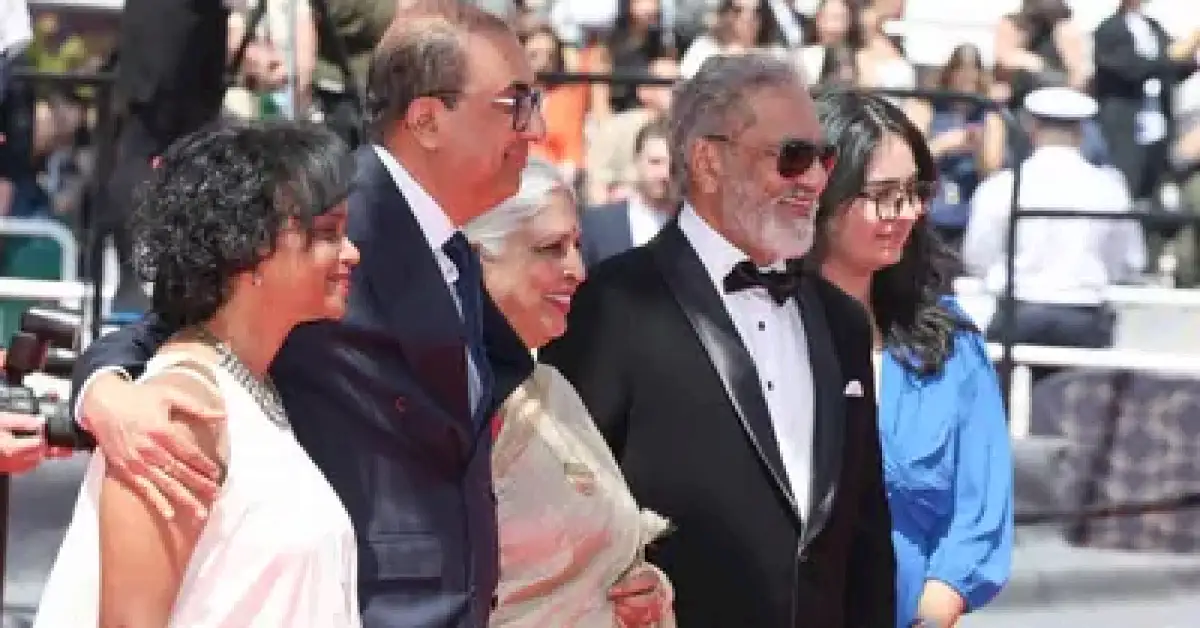
The 1986 Malayalam cult classic Amma Ariyan (Report to Mother) received a standing ovation at the Cannes Film Festival on May 16, 2026. The restored 4K version of late filmmaker John Abraham’s final work played to a full house in the Cannes Classics section, nearly 40 years after it was first made.
The film never got a commercial release when it was completed in 1986. But on the French Riviera, audiences stood and applauded this black-and-white political drama. The screening marked the only Indian feature film selected for a world premiere at this year’s festival.
A Film That Was Never Meant for Theatres
Amma Ariyan was not a regular movie. John Abraham, known as one of the most radical voices in Indian cinema, refused to follow the usual rules of filmmaking. He did not care about polished visuals or commercial success. Instead, he made raw, political films that asked hard questions.
The story takes place in 1970s Kerala, during a time of strong political unrest. The film follows a young man named Purushan, played by Joy Mathew, who travels across the state to tell a mother that her son has died. Along the way, he picks up companions, and the journey turns into something bigger. It becomes a personal and political trip about memory, ideology and resistance.
Abraham blended documentary-style filming with fiction. The movie runs 115 minutes and uses a non-linear narrative. It feels like a letter from a son to his mother, covering deep topics about loss and political anger.
How the Film Got Made with Public Money
Making Amma Ariyan was as unusual as the film itself. John Abraham could not find regular producers to fund his project. So he did something different. He started the Odessa Collective, a group of film lovers who decided to raise money from ordinary people.
Members of the collective traveled from village to village across Kerala. They performed street plays and screened films. They asked common people to donate whatever they could. Some gave just two rupees. Others gave 20 or 50 rupees. Slowly, the money came together.
This made Amma Ariyan one of India’s first crowd-funded movies. Students, workers, activists, and regular cinema lovers all helped pay for it. The film belonged to the people who funded it. And when it was ready, Abraham did not send it to normal theatres. Instead, the collective showed it in schools, parks, libraries, and public spaces.
The Tough Road to Restore the Film
Bringing Amma Ariyan back to life was not easy. The original camera negative had disappeared long ago. For many years, only poor-quality, damaged copies existed. The Film Heritage Foundation (FHF) started looking for usable prints in 2023.
After a global search through film archives, workers found just two 35mm prints at the National Film Archive of India. One had subtitles. The other did not. Both prints had serious damage. There were scratches, broken splices, sound problems, and loss of emulsion.
The restoration team sent the prints to L’Immagine Ritrovata laboratory in Bologna, Italy. Workers fixed the film frame by frame. For the sound, they made over 4,000 corrections to remove noise and dropouts. The whole restoration took nearly two years.
Bina Paul, the film’s editor, stayed closely involved in the process. She made sure the restored version kept the original raw look and feel. Cinematographer Venu, who shot the film, also supervised the work.
What Happened at the Cannes Screening
The screening took place on May 16 in Cannes. Thierry Fremaux, the Director of the Cannes Film Festival, introduced the movie to the audience. He was joined by Shivendra Singh Dungarpur, Director of the Film Heritage Foundation, lead actor Joy Mathew, and editor Bina Paul.
The room was completely full. After the film ended, the crowd stood up and clapped. The Film Heritage Foundation shared on Instagram, “Four decades after it was made, the film that was never released commercially got a standing ovation at Cannes.”
Gerald Duchaussoy, Head of Cannes Classics, called Amma Ariyan one of the best films the festival received this year. He said, “I was blown away by the intensity that runs throughout the film, the camera movements, the colour scheme, and the political atmosphere.”
The Man Behind the Film
John Abraham was not a typical filmmaker. He directed only four feature films before his death in 1987 at age 49. He fell and died just one year after completing Amma Ariyan.
But in that short time, he became a legend. The British Film Institute included Amma Ariyan in its list of the ten greatest Indian films of all time in 2001. Writer K.M. Seethi once described Abraham’s vision this way:
“John Abraham belonged to a rare breed for whom cinema was not just an art, but a public act of resistance, thought and love.”
At the Cannes screening, Joy Mathew spoke about what the film meant. He recalled how the Odessa Collective gathered money from common people. “Most of the people on the screen are not with us today. A few of them have survived, but all of these people on the screen are historical legends now after 40 years because of the film,” he said.
Shivendra Singh Dungarpur, who helped restore the film, said it changed his life when he saw it as a student at FTII. He said, “The movie made me more perplexed, complexed, and wanted me to be a filmmaker, get down to the street, and be part of a movement.”
A Big Moment for Indian Cinema
Amma Ariyan’s selection at Cannes continues a strong run for restored Indian films at the festival. This marks the fifth straight year that an Indian film has played in the Cannes Classics section. Previous selections included Satyajit Ray’s Aranyer Din Ratri (2025), Shyam Benegal’s Manthan (2024), and Aribam Syam Sharma’s Ishanou (2023).
Bina Paul said the restoration project itself is as historic as the film. She explained that getting permissions and finding good source material took real effort. “I don’t think that Amma Ariyan can be made again – because the film belongs to that time,” she said.
For Joy Mathew, who made his acting debut in this film, the Cannes moment was deeply personal. He said the film can be seen in three ways. First, as a challenge to regular commercial cinema. Second, as a rejection of normal theatre distribution. And third, as a truthful capture of the political mood of the 1970s and 80s in Kerala.
Also Read: Outlander Season 8 Finale Ending Explained: Jamie’s Final Goodbye and Claire’s Breath of Life
Looking for more updates on classic cinema and film festival news? VvipTimes brings you the latest from around the world of entertainment.


Leave a Reply