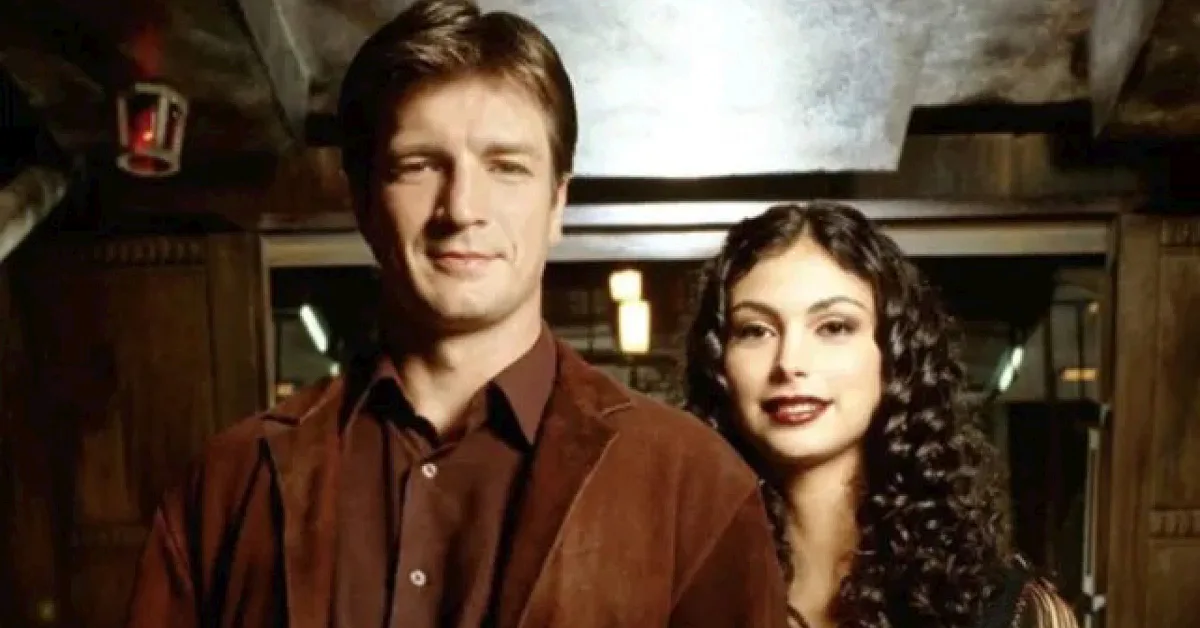
It has been nearly 24 years since Fox made the controversial decision to cancel Joss Whedon‘s space western Firefly after airing only 11 of its 14 episodes. The show, which starred Nathan Fillion as Captain Malcolm Reynolds, followed the nine crew members aboard the transport ship Serenity as they navigated life on the fringes of a futuristic society controlled by the oppressive Alliance. Despite its short run, the series developed a passionate fanbase that has kept the franchise alive through DVD sales, the 2005 film Serenity, comic books, and conventions.
Now, with Nathan Fillion confirming in March 2026 that an animated revival is in advanced development with the original cast returning, fans are revisiting what went wrong with the original series. The cancellation of Firefly remains one of the most debated decisions in television history, with multiple factors contributing to its demise. Understanding what really happened helps explain why the show failed initially while also highlighting why the upcoming animated project represents a second chance two decades in the making.
Fox Network Mishandled Firefly From the Very Beginning
The primary reason for Firefly’s cancellation traces back to how Fox handled the show before it even aired. Network executives never seemed to understand what they had purchased from Joss Whedon, and they made several critical errors that doomed the series from the start.
Fox insisted on airing episodes out of order, which confused viewers who tuned in expecting a coherent story. The two-hour pilot, “Serenity,” which established the characters, the ship, and the post-civil war universe, was rejected by Fox as too slow. Instead, the network aired “The Train Job” as the first episode, leaving audiences with no context for who these people were or why they were running from the Alliance. Adam Baldwin, who played Jayne Cobb, explained that the network’s decisions made it nearly impossible for the show to find its footing.
“Our pilot was two hours, which didn’t help us,” Baldwin recalled in a retrospective interview. “Two-hour episodes are tough when it comes to holding audience attention spans.”
Fox also scheduled Firefly in the worst possible time slot: Friday nights at 8:00 PM. This period, often referred to as the “Friday night death slot,” has historically been where networks send shows they don’t expect to succeed. To make matters worse, the show faced constant pre-emptions due to baseball broadcasts and other programming.
Alan Tudyk, who played the beloved pilot Wash, noted that the network’s lack of commitment was visible in small but telling ways. “They kept preempting us for baseball and then some Adam Sandler movie, which got better ratings than we were getting,” he said. More revealing was the fact that Fox didn’t even provide craft services for the cast. “Fox made us pay for our lunches. We’d have to go to the commissary to buy it and that wasn’t worked into the schedule, so we had to make it over there and eat in costume sometimes. Which was very weird. I’ve never had that experience again on anything else I’ve done.”
Low Ratings Gave Fox a Reason to Pull the Plug
While network mishandling contributed significantly to the show’s struggles, the reality is that Firefly simply did not attract enough viewers during its initial run to justify its production costs to Fox executives. The show averaged around 4.7 million viewers, which was below what the network expected from a high-budget sci-fi series.
Jewel Staite, who played Kaylee Frye, remembered seeing the writing on the wall when she drove past the premiere party for another Fox show, Fastlane. “I had a pretty good feeling that we were going to be canceled,” she said. “I remember driving home from work one night along Sunset Boulevard and one of Fox’s other new shows, ‘Fastlane,’ was having this huge premiere party with a red carpet and press and everything. I just drove by it, like, ‘Cool … I better start packing.’”
The irony, as Staite pointed out, is that Fastlane was also canceled after its first season and has been largely forgotten, while Firefly has endured for decades. “They don’t have ‘Fastlane’ conventions now, do they?” she added.
Fox officially canceled Firefly in December 2002 after airing 11 of the 14 produced episodes. The final three episodes would not air on the network until later, if at all, depending on the market.
Fans Tried to Save the Show But Couldn’t Overcome Network Decisions
Even before Fox made the cancellation official, Firefly fans had already begun organizing to save their favorite show. Letter-writing campaigns and online petitions circulated among the growing fanbase, which had discovered the series through word of mouth and early internet forums. These efforts, while passionate, ultimately failed to convince Fox to reverse its decision.
The campaign was not only unsuccessful in stopping the cancelation, but it also failed to secure the show’s revival in those early years. However, the fan dedication did not go unnoticed by the cast and crew, and it eventually contributed to Universal greenlighting the 2005 film Serenity, which served as a continuation and conclusion to the story.
The Creative Vision Clashed With Network Expectations
At its core, Firefly was a difficult show to categorize and market. The blend of science fiction with western aesthetics, mixed with Joss Whedon‘s signature dialogue and character-driven storytelling, created something unique. But unique does not always translate to immediate commercial success, and Fox executives struggled to find the right way to present the show to audiences.
The network’s promotional materials often focused on the wrong aspects of the series, failing to capture what made it special. Trailers emphasized action over character, and the network’s insistence on airing episodes out of order meant that character arcs and relationships developed in ways that made little sense to casual viewers.
The show also carried a significant budget for a first-year series. The visual effects, sets, and practical locations required substantial investment, and when the ratings didn’t materialize, Fox had little incentive to continue funding what they viewed as an underperforming asset.
The Animated Revival Offers a Second Chance
Fast forward to March 2026, and Nathan Fillion has announced that an animated Firefly revival is in advanced development at 20th Television Animation. The announcement came during a panel at Awesome Con in Washington, D.C., where Fillion appeared alongside several original cast members including Alan Tudyk, Gina Torres, Jewel Staite, Morena Baccarin, Sean Maher, and Summer Glau.
The project, which is being developed through Fillion‘s production company Collision33, will reunite the core cast to voice their original characters. Adam Baldwin is also expected to return as Jayne Cobb. The only original cast member unable to participate is Ron Glass, who portrayed Shepherd Book and passed away in 2016.
Marc Guggenheim and Tara Butters are attached as showrunners, with scripts already completed. The animation studio ShadowMachine, known for work on BoJack Horseman, will handle the visuals. Importantly, the series will take place between the timeline of the original 2002 show and the 2005 film Serenity, preserving continuity while allowing the cast to return despite the passage of time.
Joss Whedon, who created the original series, is not directly involved in the animated project, but Fillion confirmed that Whedon has given the revival his blessing.
The proposed series currently needs a streaming platform to call home. Fillion has launched a social media campaign asking fans to engage with posts about the project to generate “quantifiable analytics” that can demonstrate demand to potential buyers. Given that 20th Century Studios is owned by Disney, Disney+ remains the most likely home for the series, though no official deal has been announced.
Fillion addressed fans directly in a video shared on social media, saying, “The dedication of Firefly fans has kept this 25-year-old show relevant. Clearly, the return of Firefly is something the fans want. More importantly, it’s something they deserve.”
Also Read:



Why Animation Makes Sense for a Firefly Return
Choosing animation for the Firefly revival solves several practical problems that would have made a live-action continuation difficult. The original cast is now more than two decades older than their characters were in the show, but their voices remain recognizable and full of the personality that made the characters beloved.
Animation also allows the creative team to tell stories that might have been too expensive or technically challenging in live-action. The ship can travel to more worlds, action sequences can be more elaborate, and the distinctive visual style of Firefly can be maintained while updating it for modern audiences.
The decision to set the series between the show and the movie means that characters who did not survive the events of Serenity can still appear, and the story can explore the period that fans have wondered about for years.
Also Read: New ‘Battle Spirits [Re]’ Anime Confirms Fall 2026 Premiere in Explosive Teaser Trailer
Stay connected with VvipTimes for more breaking entertainment news and updates on your favorite sci-fi franchises as they develop.