

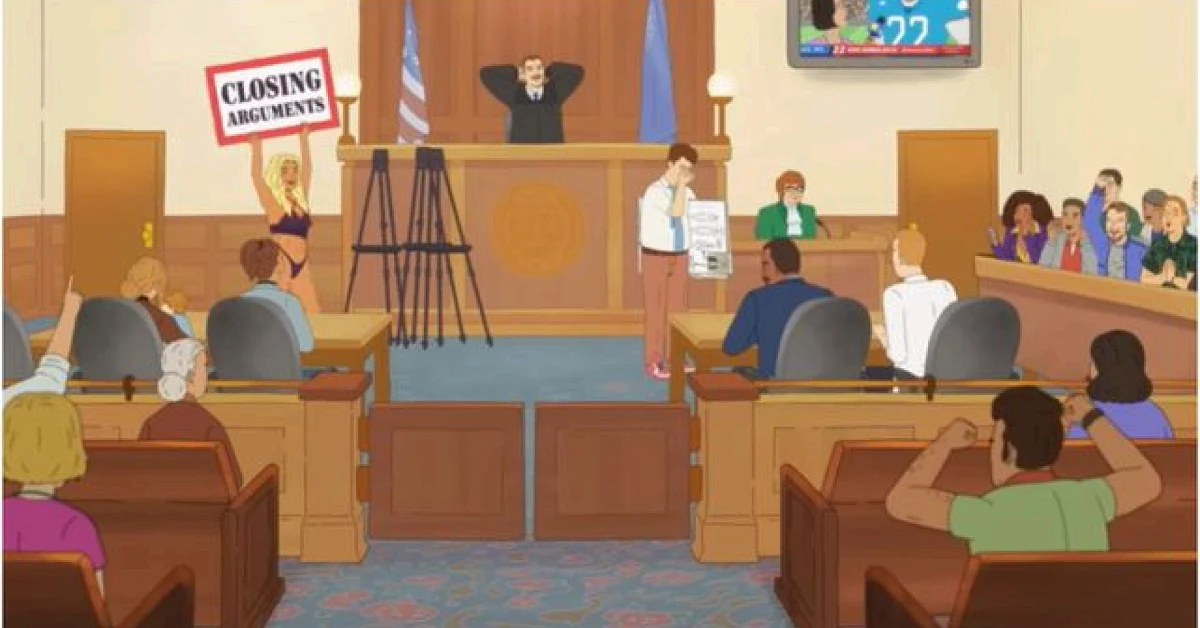
The new Netflix adult animated comedy Strip Law dropped all 10 episodes on February 20, and viewers who made it through the wild ride to the finale might still be processing what they just watched. The show, created by Cullen Crawford (Star Trek: Lower Decks, The Late Show With Stephen Colbert), follows Lincoln Gumb (voiced by Adam Scott), a straight-laced Vegas lawyer who runs a failing firm inherited from his late mother. He teams up with flamboyant street magician Sheila Flambé (Janelle James) to bring spectacle to his court cases, but it’s the bizarre journey of the office’s strangest character that has everyone talking.
The finale wraps up the first season with a twist that completely redefines one character while setting up a new normal for Gumb Legal. Here is the breakdown of what actually happens to Glem Blorchman and what his transformation means.
Strip Law season 1 sets up a world without rules
Before getting into the ending, it helps to understand the world of Strip Law. The show takes place in a hyper-real, exaggerated version of Las Vegas where logic takes a backseat to entertainment. Lawyers have to put on shows to win cases, judges care more about holidays than legal procedures, and the city is filled with bizarre characters like the Hot Dates (a raunchy version of the California Raisins) and a bartender who switches between Irish and Italian accents mid-sentence.
Lincoln Gumb runs the small firm Gumb Legal with his teenage niece Irene (Shannon Gisela) as his investigator and the elderly, disbarred Glem Blorchman (Stephen Root) hanging around causing confusion. Throughout the season, Steve Nichols (Keith David), Lincoln’s mother’s former partner, serves as the successful rival trying to push Lincoln out of the legal game entirely.
The season balances standalone cases with ongoing character development, particularly the unexpected partnership between Lincoln and Sheila, which avoids the typical will-they-won’t-they romantic tension and settles into a genuine working friendship built on mutual weirdness.
Who is Glem Blorchman before the finale
Glem Blorchman serves as the office’s resident oddball through most of the season. He is a disbarred lawyer with strong “creepy uncle” energy who offers questionable advice and makes bizarre statements that leave everyone confused. In one early episode, he casually mentions it is “115 degrees out so I put marshmallows in gin” while the team gathers to watch Christmas movies .
But the show drops hints about Glem’s past that become important later. He claims to have been the original bass player for the influential 90s punk band Bikini Kill, though when Irene questions this, he responds: “I don’t know what Bikini Kill is. Neither did I, according to Kathleen Hanna” . This throwaway line about the band’s actual lead singer suggests Glem’s relationship with reality is complicated at best.
Throughout the season, Glem gets “rebarred” (allowed to practice law again), though his contributions to cases remain confusing and minimally helpful. He exists as comic relief until the finale, when the show reveals there is much more to him than lazy writing.
The Strip Law finale explained
The final episode of Strip Law takes a completely different approach from the rest of the season. Instead of following the usual format, the episode presents itself as the finale of a completely different law show . This fictional series appears to be a straightforward legal dramedy in the style of Suits or Boston Legal, with handsome lawyers handling serious cases and delivering dramatic speeches.
In this alternate reality show, Lincoln and the Gumb Legal team show up as supporting characters. The stars of this other show comment on them, saying: “It’s against their nature to let something be sweet and fun and airy. They have to make it dark and strange and crass” . This meta-commentary basically describes the difference between Strip Law and traditional legal shows.
The framing device allows the creators to comment on their own series while telling the actual story. Within this alternate show’s finale, the dramatic lawyers face a crisis, and Lincoln’s team gets pulled into helping. But the real action happens beneath the surface.
What does Glem turn into in Strip Law ending
The biggest reveal comes through Glem Blorchman’s transformation. Throughout the episode, while the other characters navigate the parody legal drama, Glem undergoes a strange metamorphosis. The show has established that Glem is disconnected from reality, but the finale suggests this might be because he is connected to something else entirely.
Glem gradually transforms throughout the episode, though the show keeps the visual details intentionally vague. What viewers can piece together from the finale is that Glem becomes something beyond human, a being that exists partially in our reality and partially somewhere else. His ramblings about Bikini Kill and his confused statements throughout the season weren’t senility, they were signs that his perception worked on a different level.
The transformation allows Glem to perceive the meta nature of their existence. He understands that he and the other characters exist within a show, and more specifically, within the finale of a show that is pretending to be a different show. This layered awareness makes him the only character who truly understands what is happening.
By the end of the episode, Glem has fully transformed into this new state of being. He doesn’t become a monster or a superhero in the traditional sense. Instead, he becomes something the show can’t quite define, a being that exists outside the normal rules of their animated world.
What Glem’s transformation means for Strip Law season 2
The finale leaves Glem in this transformed state as the show returns to its normal reality. The framing device ends, and viewers come back to the regular Strip Law world. But Glem remains changed.
He now possesses knowledge and awareness that other characters lack. He understands the artificial nature of their situations, the tropes they follow, and probably much more. This sets up potential storylines for a second season where Glem could serve as a guide through even stranger adventures or become an unpredictable wild card whose perception constantly shifts.
The showrunners have positioned Glem as the audience surrogate in a strange way. Viewers watch a cartoon that knows it is a cartoon. Glem now knows he is a cartoon character in a cartoon that knows it is a cartoon. The layers of meta-awareness create endless possibilities for humor and storytelling.
Stephen Root‘s voice performance throughout the season sells this transformation. What could have been a one-note weird old man character gains depth through Root’s delivery, making the finale reveal feel earned rather than random.
How the finale wraps up other character arcs
While Glem’s transformation provides the biggest surprise, the finale also gives satisfying conclusions to other storylines. Lincoln finally comes to terms with his complicated feelings about his late mother. Throughout the season, he struggled to live up to her legacy while also resenting her for being a subpar parent who prioritized her career . The meta-finale allows him to process this in the context of the fake law show, where mother issues would be handled with dramatic speeches and emotional music.
Sheila Flambé solidifies her place at Gumb Legal. Her partnership with Lincoln evolved from a desperate business move to genuine friendship, and the finale shows her fully committed to the firm’s weird future. Janelle James brings the same confident energy to Sheila that makes her character Principal Ava on Abbott Elementary so entertaining, but Sheila has more depth beneath the surface .
Steve Nichols gets his comeuppance in a way that fits the show’s style. The rival lawyer who spent the season trying to destroy Lincoln’s firm ends up humiliated not by legal maneuvering but by the sheer absurdity of Gumb Legal’s approach. Keith David‘s authoritative voice makes Nichols a credible threat, which makes his downfall funnier .
Irene, Lincoln’s teenage niece, continues developing as the show’s most grounded character. Her deadpan reactions to the chaos around her provide essential balance, and the finale gives her moments to show she cares about her weird family despite everything.
The Hot Dates subplot connects to the ending
One ongoing element throughout Strip Law involves the Hot Dates, a group of stop-motion animated characters who function as a sleazier version of the California Raisins . They pop up throughout the season, performing and causing minor chaos.
In a mid-season episode, the Hot Dates face controversy when they get redesigned to look more respectable. Lincoln laments that “They’re walking away from years of established canon” , a joke about how franchises handle character updates that sparks riots in the show’s Vegas.
This subplot connects to the finale’s themes. Both the Hot Dates redesign and the meta-finale deal with questions of identity and change. Characters in Strip Law can transform, whether through redesign, personal growth, or cosmic weirdness like Glem’s metamorphosis. The show argues that change is constant and usually ridiculous.
Why the Strip Law ending works
The finale succeeds because it stays true to what made the show work throughout its first season. Strip Law built its identity on joke density, meta-humor, and willingness to try anything . A finale that suddenly became serious would have betrayed the series. Instead, the creators doubled down on their strengths while still delivering emotional payoff.
The decision to frame the finale as another show entirely allows Strip Law to comment on television conventions while telling its own story. The characters from the fake dramedy describe Lincoln’s team as people who “have to make it dark and strange and crass” , which is exactly what Strip Law does. The show acknowledges its own approach while celebrating it.
Glem’s transformation works as the centerpiece because he was always the most mysterious character. His bizarre statements and disconnected behavior throughout the season weren’t random, they were hints that he perceived reality differently. The finale confirms this and takes it to its logical extreme.
Related:










What viewers should know about watching Strip Law
All 10 episodes of Strip Law are now streaming on Netflix globally. The show carries an adult rating for language, sexual content, and violence, though the violence is presented in ridiculous, cartoonish ways .
New viewers should go in expecting something closer to Adult Swim sensibility than network animation. The show draws comparisons to Rick and Morty but has its own distinct voice, focusing more on workplace comedy and Las Vegas weirdness than sci-fi adventures . The joke density means episodes reward repeat viewing, with background gags and throwaway lines that become funnier on second watch.
The voice cast delivers strong performances across the board. Adam Scott perfectly plays the straight man surrounded by chaos. Janelle James brings star power to every scene. Stephen Root makes Glem memorable even before the transformation. And Keith David could read a phone book and make it sound important .
For viewers who made it through the whole season and wondered what Glem turns into, the answer is deliberately open-ended. The show doesn’t explain his new form in concrete terms because that would defeat the purpose. Glem now exists beyond explanation, a being who understands the true nature of his world and maybe other worlds too. Whether season 2 explores this further or treats it as a one-time gag remains unknown. But for now, Glem Blorchman stands as one of the strangest characters in adult animation, transformed into something viewers will be talking about until the show returns.
Also Read: Under Salt Marsh Episode 6 Finale Release Date and Time Confirmed for February 27 on Sky and NOW
Stay connected with VvipTimes for the latest updates on Netflix releases, animated series, and all your favorite shows streaming in 2026.





























































































Leave a Reply