

Space exploration is one of the hardest things humans have ever tried to do. NASA has scored some amazing wins, but there have also been times when missions went terribly wrong. From blown-up oxygen tanks to simple math errors that cost millions, these five NASA disasters show just how quickly things can fall apart when you’re reaching for the stars.
Apollo 13: The Successful Failure That Almost Killed Three Astronauts
April 13, 1970 started like any other day for the Apollo 13 crew. Jim Lovell, John Swigert, and Fred Haise were about 200,000 miles from Earth, getting ready for America’s third moon landing. Then everything changed.
Nine minutes after the crew finished a TV broadcast, an oxygen tank inside the service module exploded. The blast damaged the second oxygen tank too. The command module lost its normal supply of electricity, light, and water. The moon landing was cancelled immediately. Now the only goal was bringing the three men home alive.
The crew moved into the lunar module, which was designed to land on the moon, not to keep three people alive for days in deep space. Engineers on the ground worked around the clock to figure out how to get them back with very little power and a rising carbon dioxide problem. They built a makeshift adapter using parts from the spacecraft to fix the air system.
The explosion happened because of a mistake made back in 1965. NASA had raised the voltage to the heaters in the oxygen tanks from 28 to 65 volts DC. But nobody changed the thermostatic switches on those heaters. During a test on the launch pad, the heaters stayed on too long, hitting temperatures of 1,000 degrees Fahrenheit. This severely damaged the Teflon wiring insulation. When the tank was filled with oxygen again in space, it exploded.
The crew splashed down safely in the Pacific Ocean on April 17, 1970. NASA called it a “successful failure” because they lost the mission but saved the crew.
Challenger Space Shuttle Disaster: Seven Lives Lost in 73 Seconds
January 28, 1986 was supposed to be a special day. Christa McAuliffe, a school teacher, was on board the Challenger space shuttle, chosen from 11,000 applicants for NASA’s Teachers in Space program. Millions of school children watched the launch live on TV.
Just 73 seconds after liftoff, the shuttle exploded. All seven crew members died. CNN reporter John Zarrella, who covered the launch, said the image of Challenger being engulfed in smoke with boosters spinning out of control is still etched in his brain. He was pulled aside by his cameraman who saw more through the lens and simply said: “It blew up.”
Nine-year-old Michael Grothaus watched from his classroom. He remembers looking at his teacher, who had a look of disbelief on her face. She flipped the channel and ran into the hallway. He called it “soul-crushing.”
The investigation took four to five months. General Don Kutyna, who served on the presidential commission, said the biggest job was ruling out all the other theories people were coming up with. The cause turned out to be a faulty seal called an O-ring. The cold weather on launch day made the rubber seal fail, allowing hot gases to escape and destroy the external fuel tank.
Space travel had become routine before Challenger, but it never felt that way again. The shuttle program stayed grounded for 32 months.
Columbia Space Shuttle Disaster: A Piece of Foam That Cost Seven Lives
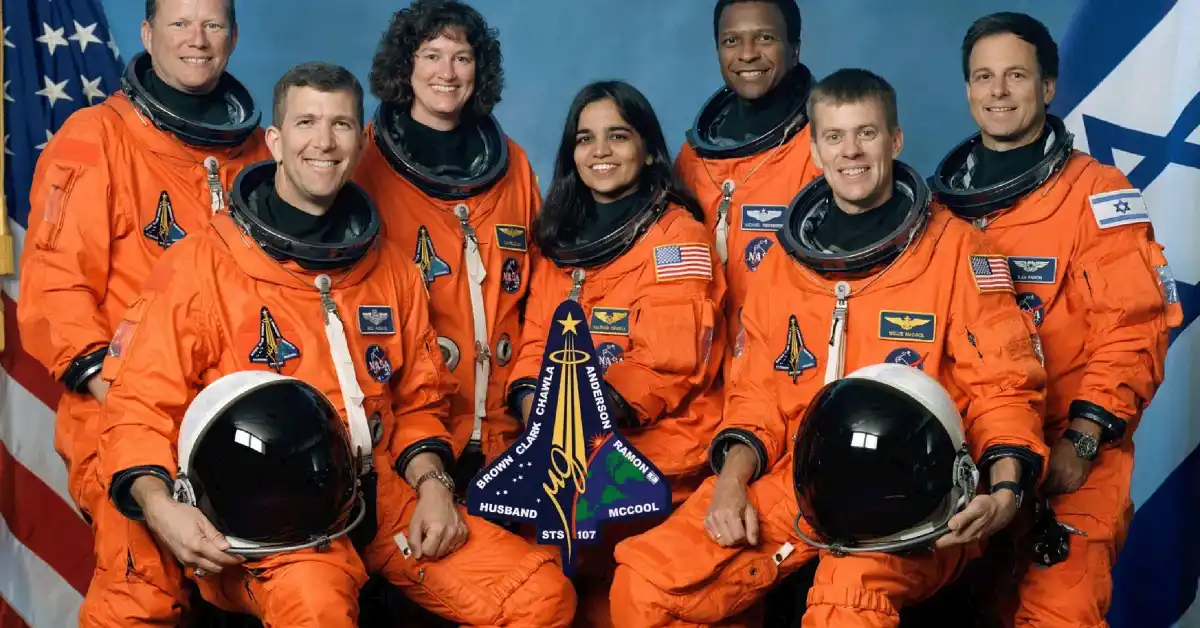
February 1, 2003 started like any other return from space. The Columbia shuttle was coming home after a 16-day mission. But something had gone wrong during launch two weeks earlier. A piece of foam insulation, weighing about 1.67 pounds, had broken off the external fuel tank and hit the left wing. NASA had seen foam strikes on nearly every mission and considered them low risk.
As Columbia re-entered Earth’s atmosphere, superheated gas at about 1,600 degrees Celsius entered the damaged wing through a hole the foam had created. The gas melted the wing’s interior structure. The shuttle broke apart over Texas and Louisiana. All seven astronauts died.
Dr. Jonathan Clark lost his wife Laurel Clark on that mission. He worked for NASA at the time and knew about the potential problems. He had to decide whether to use his connection as a family member to tell the rest of the crew. He chose not to tell them. He said a day doesn’t go by that he doesn’t think about it.
The Columbia disaster happened 17 years and 87 shuttle flights after Challenger.
Mars Climate Orbiter: A $327 Million Math Mistake
September 23, 1999 was the day NASA’s Mars Climate Orbiter was supposed to start studying Mars’ weather. The probe had traveled for nine months to reach the Red Planet. The plan was to use the drag from Mars’ thin atmosphere to slow down and enter orbit.
Instead, the spacecraft’s signal vanished. It was never heard from again. The reason? A simple math error. Lockheed Martin, the company that built the probe, provided data in pound-force seconds, the standard in the US aeronautical industry. But NASA’s Jet Propulsion Laboratory uses metric units: newton-seconds. The difference was a factor of 4.45.
This mix-up meant the Mars Climate Orbiter approached the planet at an altitude of less than 60 miles instead of the planned 93 miles. At that lower altitude, the atmosphere was so thick that the friction acted like a blowtorch against the spacecraft. It either burned up, broke apart, or exploded. The mission cost $327 million.
The failure was so humiliating because it was completely preventable. The investigation also revealed poor organization, lack of training, and communication problems between companies.
You May Also Like:










Hubble Space Telescope Mirror Flaw: A $1.5 Billion Blurry Vision
When the Hubble Space Telescope sent back its first images on May 20, 1990, the excitement quickly turned to disappointment. The pictures were blurry. Tests showed that the main mirror had a manufacturing defect. It was the wrong shape.
Engineers had ground the mirror perfectly, but they ground it to the wrong curve. The edge of the mirror was too flat by about 1/50th the width of a human hair. That tiny error made all of Hubble’s images fuzzy. NASA had spent $1.5 billion building and launching the telescope, and it couldn’t see properly.
The good news was that scientists could fix the problem. Not by replacing the mirror, but by building a set of corrective lenses, like eyeglasses for the telescope. In December 1993, space shuttle astronauts installed these new instruments during a servicing mission. Hubble went from a national embarrassment to one of the most important scientific tools ever built.
Technicians were able to electronically massage the data to recover high-definition images, but at the cost of losing some light-gathering power.
Also Read: Daredevil: Born Again Season 2 Episode 4 Watcher Cameo and Vanessa Shocking Fate Explained
Stay updated with more space and science news on VvipTimes, where we break down complex topics into stories you can actually understand.


Leave a Reply