

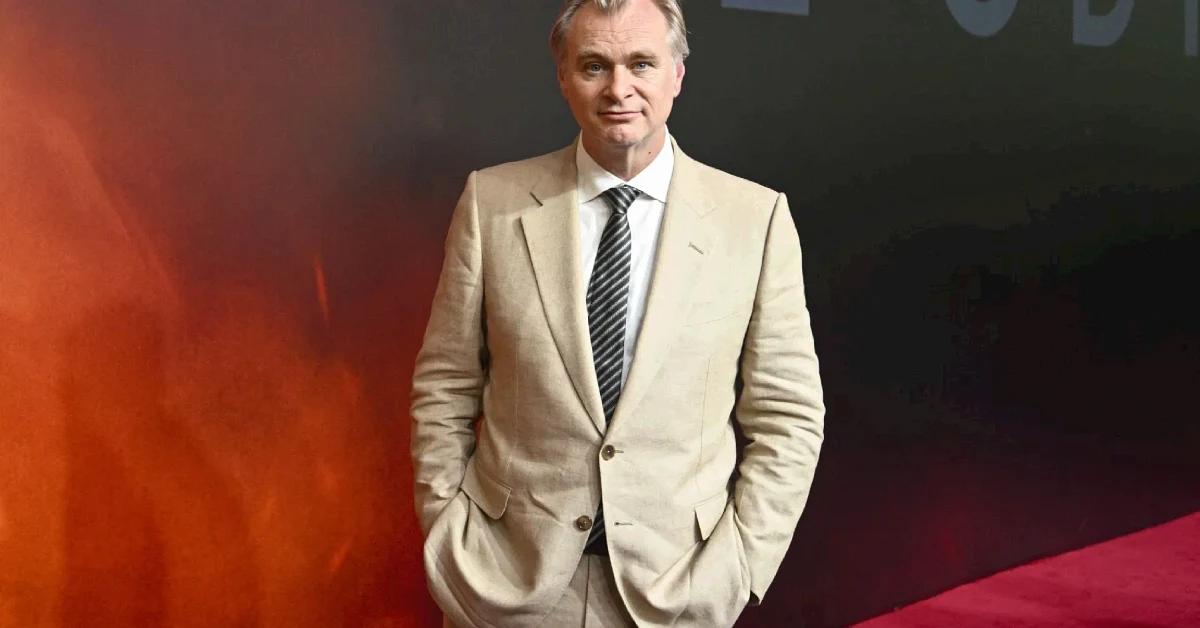
Christopher Nolan’s epic adaptation of Homer’s ancient Greek poem, The Odyssey, has taken the world by storm. The film, which hit theaters on July 17, 2026, has already crossed $300 million at the global box office. But behind the massive success lies a production that pushed everyone involved to their absolute limits.
The Oscar-winning director behind Inception, Interstellar, and Oppenheimer has now opened up about why this project stands as the most physically and technically demanding film of his entire career. From shooting on real ships in stormy oceans to building a 60-foot Cyclops, Nolan and his cast went through an experience that felt more like an expedition than a movie set.
“I definitely hit the limits of my own stamina and everybody’s stamina, I think. I mean, it’s The Odyssey – of course it should be difficult. We’re not doing the job right making a film of The Odyssey if it doesn’t seem difficult.”
Why the Scale of the Story Made It So Hard
Nolan told CBS Mornings that the sheer magnitude of the source material was the biggest challenge from the start. He explained that adapting one of the most famous epics in Western literature meant the film had to feel massive in every way.
“For us, it was just the sheer magnitude of it’s ‘The Odyssey,’ it should be hard. We’re going to go out there and we’re going to make it as well as we can.”
The director knew from the beginning that a story this big would not be easy to bring to the screen. He wanted to create something audiences had never seen before, which meant pushing his technical limits and making a film that felt bigger than anything he had done previously.
Filming Across Six Countries With No Green Screen
One of the main reasons The Odyssey became Nolan’s hardest film was his decision to shoot in real locations across six countries instead of using studio sets or green screens. The production traveled to Greece, Italy, Iceland, Morocco, Scotland, and the United States.
Matt Damon, who plays Odysseus in the film, described the experience as unlike any other movie he has worked on. He told CBS Mornings that the shoot often felt more like an expedition than a film production.
“It was the hardest movie definitely that I’ve ever done. It felt in a lot of ways more like an expedition than a movie because of the locations we were at. We’d be shooting on top of a mountain. We’d have to hike up the mountain to shoot.”
Damon also revealed that Nolan warned him before filming began about how tough the production would be. The actor explained that Nolan’s dedication to practical filmmaking played a major role in the difficulty.
“Chris likes to shoot everything real. So there’s no kind of green screen, no faking it, no kind of studio stuff.”
The cast and crew had to hike for 45 minutes uphill every day for two weeks to reach one of the filming locations. Some days started with climbing a mountain just to get to the set. Damon added that the physical demands were constant.
“When you’re uncomfortable – and you are most of the time, physically, just by nature of what’s required to get these shots – if you turn and look over your shoulder, he’s no more than five feet away and doing the same thing without complaint.”
The production also faced extreme weather conditions, including high winds and pounding rain that battered the cast and crew on ships out in the open ocean. Filming inside a cave proved challenging for several reasons, including a curtain of bees blocking the entrance.
The First Feature Film Shot Entirely on IMAX
Nolan achieved a long-held dream with The Odyssey by making it the first commercial feature film shot entirely on IMAX cameras. He recalled telling the IMAX team before production began.
“If ever we are going to fulfill this dream of shooting the entire movie that way, this is the one. This is ‘The Odyssey.’”
But shooting entirely on IMAX came with its own set of challenges. The film reels only lasted for just under three minutes before running out. This meant the crew had to reload the camera frequently, forcing actors to stay in the same emotional state during intense scenes while waiting for filming to resume.
“The film is huge. … So after each, sort of just under three minutes, you run out of film. So you have to ask the actors on a longer scene to just stay in the emotional state that they’re in, however intense that is, and then you quietly reload the camera and keep everybody focused and then start the scene again.”
For Nolan and his cinematographer, Hoyte van Hoytema, IMAX invented a special “blimp system” to encase and maneuver the enormous and loud camera. Cast members even used mirrors to see each other around the bulky equipment. It was only halfway through the six-country shoot that Nolan felt confident the ambitious IMAX plan would actually work.
Creating the Cyclops Without Relying on CGI
Bringing the Cyclops to life was one of the most difficult technical tasks Nolan has ever faced in his directing career. The director called it a “terrifying challenge” to create the 60-foot character.
As with the rest of the film, Nolan wanted to avoid relying heavily on CGI. Instead, he used practical effects, puppetry, and animatronics to make the Cyclops feel real.
“Everything about the Cyclops sequence is aimed at trying to imagine: what would this be like in real life? Not approaching it from a storybook or cartoony point of view, but really trying to be in there with Odysseus and his men. It’s a horrifying situation.”
Nolan reunited with Bill Irwin, who previously puppeteered and voiced the robot TARS in Interstellar, to help bring the Cyclops to life. The director explained that he wanted to give audiences a reason to believe in the extraordinary elements of the story.
“My rule of thumb for everybody involved in the film was ‘give them a reason to believe’. You know, as the movie goes on, we want to see extraordinary things, we want to go to extraordinary places. So, we need a reason to believe.”
Nolan said he “used every trick in the book,” from puppetry to animatronics, but the smartest decision was getting Irwin to help “find this guy from the inside”. He noted that he learned from his friend Guillermo Del Toro that a monster is never just a monster.
“It’s really about finding the individual behind that, and, in that way, presenting a more real and a more threatening character. The cyclops is a real character.”
The Cast and Crew Reached Their Limits
The production scheduled 100 days of filming but wrapped in 91 days. Nolan admitted that by day 91, they could not have taken another step. The director confessed that the experience tested his own physical and mental limits.
“I definitely hit the limits of my own stamina and everybody’s stamina, I think.”
Nolan’s commitment to authenticity meant the cast and crew endured conditions that would have been avoided in a typical studio production. But for the director, putting audiences on the deck of that ship meant getting out on a real boat with real waves.
“These are great actors. You could stick them in front of a green screen and they’d do amazing. But to me, for the audience, if you want to put the audience on the deck of that ship, get out there on a real boat with Matt Damon, with Tom Holland and Zendaya. Put them in the real waves. Get that IMAX camera, put it on that action, and that way you can immerse the audience.”
Tom Holland, who plays Telemachus in the film, praised Nolan’s exceptional direction. He said the detailed screenplay gave every actor complete clarity about their characters.
You May Also Like:



The Film’s Massive Success
Despite all the difficulties, Nolan’s gamble has paid off. The Odyssey has become Nolan’s biggest global opening ever, earning $264.1 million worldwide over its opening weekend. The film also delivered the biggest live-action debut of 2026.
The movie features a star-studded ensemble cast including Matt Damon as Odysseus, Anne Hathaway as Penelope, Tom Holland as Telemachus, Zendaya, Robert Pattinson, Charlize Theron, and Lupita Nyong’o.
The Odyssey follows Odysseus as he journeys back to Ithaca to his wife Penelope and son Telemachus after winning the Trojan War. The film received an A certificate from India’s Central Board of Film Certification and passed censors without any cuts. Nolan even held the official premiere in Mumbai on July 10, 2026.
Also Read: Wind Breaker Chapter 225 Release Date and Time Confirmed for Global Fans
For more entertainment news and updates, visit VvipTimes and stay informed about the latest happenings in cinema, television, and pop culture.
































































Leave a Reply