

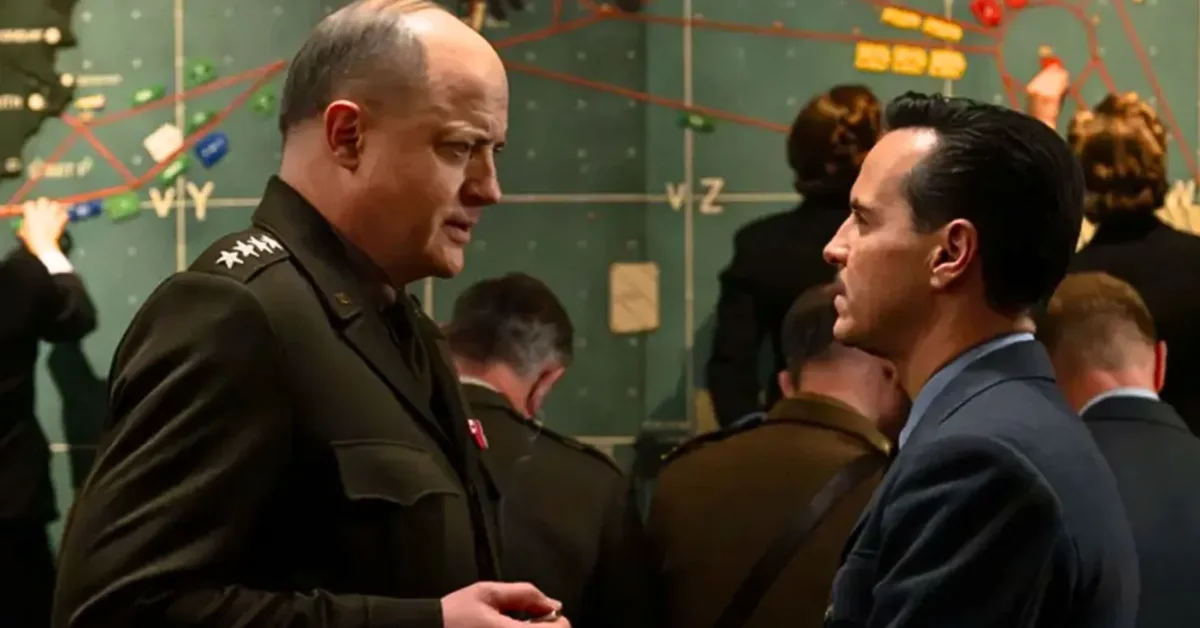
The new World War II movie Pressure arrived in US theaters on May 29, 2026, and it tells a little-known story about the weather forecast that changed history. Andrew Scott plays Group Captain James Stagg, a Scottish meteorologist who had to stand up to General Dwight D. Eisenhower (Brendan Fraser) and other top military leaders to delay the D-Day invasion. The film comes from director Anthony Maras and is based on a stage play by David Haig, who also co-wrote the screenplay. Many viewers are walking out of theaters asking the same question: How much of this actually happened?
The Real James Stagg Was a Tough, No-Nonsense Scot
James Stagg was a real person, and the movie gets his personality right. Eisenhower himself called him a “dour but canny Scot” in real life. Stagg had spent years working at weather stations in the Arctic Circle before being called to lead the D-Day forecasting team. He was known for being matter-of-fact, gruff, and not very interested in making friends with powerful people.
One surprising detail from the real story: Stagg wasn’t actually the most famous meteorologist on the team. That honor belonged to Sverre Petterssen, a Norwegian who was more highly regarded in the field. But Stagg got the top job because he understood how to work with committees and present information to military leaders. He knew how to get things done.
Stagg was appointed as chief meteorologist for the Allied forces in Europe back in November 1943, not just days before the invasion as the movie suggests. He had been working with Eisenhower for months before the big decision. According to Stagg’s own memoir, Eisenhower often stopped by his office to “ask about the weather for the rest of the day” in the weeks leading up to D-Day. Through these talks, Eisenhower learned to trust what Stagg had to say.
The Fight Between Stagg and Irving Krick Really Happened
The movie shows Chris Messina playing Irving Krick, an American meteorologist who clashed hard with Stagg over whether to launch the invasion on June 5, 1944. This conflict was very real. Krick used a method called “analog forecasting,” which meant looking at weather patterns from past years to predict the future. Stagg used more modern methods based on upper-atmosphere measurements and current data. Their disagreement was not just about weather. It was about two completely different ways of doing science.
Krick also had an unusual side job. Before the war, he worked as a weather consultant for Hollywood studios. He correctly predicted calm weather on the day the crew of Gone With the Wind filmed the famous burning of Atlanta scene. The movie includes this detail, and it is completely true.
In the film, Stagg tells Eisenhower to delay the invasion because two storms are coming. Krick says the weather will be fine. The real Krick did argue that June 5 would have clear skies based on his historical data. But in reality, there were three forecasting teams reporting to Stagg, not just two. Krick led the US Army Air Forces team. British teams from the Met Office and the Royal Navy also provided forecasts. Stagg had to take all three reports and make a final judgment.
“Stagg’s understanding of the jet stream and what it could do to those landings was ahead of its time,” Haig told USA Today. “Their clash was very genuine because Krick, with all the integrity in the world, believed that it would be safe, just as Stagg believed it would be profoundly unsafe to go on the 5th.”
Operation Tiger Was a Real Disaster That Opened the Movie
Pressure starts with a terrifying scene of Eisenhower walking along a beach covered with dead American soldiers. That was Operation Tiger, a real training exercise for D-Day that took place in April 1944 at Slapton Sands in Devon, England. Eisenhower ordered live ammunition to be fired over the troops’ heads to make the practice feel real. But a communication breakdown caused some landing craft to arrive late. The troops coming ashore came under direct fire from their own side. To make things worse, German E-boats attacked a convoy of landing ships in Lyme Bay.
The official death toll from Operation Tiger stands at 749 soldiers. The military covered up the disaster because D-Day was just weeks away. Eisenhower was terrified that if a rehearsal could go this wrong, the actual invasion might be a total catastrophe. The movie uses this event to explain why Eisenhower was so nervous about making the wrong call on the weather.
A Young Woman in Ireland Sent the Message That Changed Everything
One of the most important parts of the real story is missing from the movie. A 21-year-old woman named Maureen Flavin was working at the Blacksod Point weather station in County Mayo, Ireland. On June 3, 1944, she recorded barometer readings showing rapidly falling air pressure and force six winds. She sent this information to Britain by post office telegram. This data confirmed that a dangerous storm was approaching from the Atlantic.
Stagg used Maureen’s report to convince Eisenhower to delay the invasion from June 5 to June 6. Then, on June 4, Maureen’s future husband Ted Sweeney reported that the weather was clearing. He sent a message saying: “Heavy rain and drizzle cleared, cloud at 900 feet, and visibility on land and sea very clear.” That report gave Stagg the evidence he needed to tell Eisenhower that a small window of better weather would arrive on the morning of June 6.
The movie does not show Maureen Sweeney. Some critics have pointed out that this is a missed opportunity, since her work was so important to the final decision.
What the Movie Changed or Added for Drama
The filmmakers made several changes to turn the real events into a tighter story. The biggest change involves time. In the movie, Stagg arrives at Southwick House just days before D-Day. In reality, he had been working with Eisenhower since late 1943.
The movie also creates a friendship between Stagg and Kay Summersby (played by Kerry Condon), Eisenhower’s Irish-born secretary and driver. In real life, there is no evidence that they were close friends. Summersby was a real person, and historians still debate whether she had a romantic relationship with Eisenhower. But her connection to Stagg in the film is invented to give Stagg someone to talk to.
Stagg’s wife was pregnant during the real events, but she did not go into labor until November 1944, months after D-Day. The movie creates a scene where the hospital she is staying in gets bombed, putting her and the baby in danger. This never happened. Haig admitted that he added this to “heighten drama.”
There is one wonderful coincidence from real life that made it into the movie. During filming, the production team needed researchers to go through old war archives. One man who showed up for the job had the same name as the movie’s hero: James Stagg. The receptionist noticed the coincidence and asked if he was related. He replied, “That was my grandfather.” The baby born at the end of the real story grew up and had a son who ended up helping make the movie about his own grandfather.
Andrew Scott on Playing the Reluctant Hero
Andrew Scott, known for his roles in Fleabag and All of Us Strangers, told GQ that the story of James Stagg surprised him. “It’s this wild story about a weatherman during World War II,” Scott said. “He refused to give a forecast for the D-Day landings to go ahead because he didn’t believe it was safe. He was put under an enormous amount of pressure to give a particular type of forecast, and he absolutely refused.”
Scott also noted that the movie has funny moments, which might not be what audiences expect from a war film about weather. “It’s actually kind of wild to do a film that’s about the war and the weather,” he said.
Related:









What Eisenhower Said After the War
Years after World War II ended, President John F. Kennedy asked Eisenhower what made the difference in the success of D-Day. Eisenhower gave a simple answer: “We had better meteorologists than the Germans.” That quote sums up why Pressure tells a story about a weatherman instead of a soldier. The right forecast at the right time saved thousands of lives.
The movie is now playing in theaters across the United States as of May 29, 2026. It will release in cinemas in Ireland and the United Kingdom on September 9, 2026, followed by releases in Canada, Australia, and India later in the fall.
Also Read: For All Mankind Season 5 Finale: Kelly Baldwin’s Titan Sacrifice and the Discovery of Alien Life
For more entertainment news and streaming updates, visit VvipTimes for the latest coverage.
































































































Leave a Reply