


Netflix’s adaptation of Jo Nesbø’s Detective Hole dropped on March 26, 2026, and viewers are still processing the haunting finale. The nine-episode series, based on the fifth novel in Nesbø’s bestselling Harry Hole series, The Devil’s Star, delivers a conclusion that wraps up the serial killer case but leaves fans with a chilling post-credits scene and a major twist involving the police chief.
The show follows Tobias Santelmann as the troubled detective Harry Hole, who investigates a string of murders while battling his own demons and a corrupt colleague, Tom Waaler, played by Joel Kinnaman. By the final episode, both storylines collide in violent fashion. But it is the final moments that have everyone talking.
The Waterbed Scene That Left Viewers Speechless
The finale’s most disturbing moment comes when Harry confronts the real killer, Wilhelm “Willy” Barli (Frank Kjosas), a theater producer. During their tense exchange, Harry asks where Willy’s wife Lisbeth’s body is hidden. Willy points to his waterbed. When the bed splits open, Lisbeth’s preserved body floats to the surface, and Harry finds himself face-to-face with the corpse through the thin plastic membrane.
The scene has sparked massive reaction online, with many calling it one of the most unsettling moments in recent crime TV. What makes it even more disturbing is the real-life inspiration behind it. Jo Nesbø himself revealed in interviews that the idea came from his own experience. Years ago, a doctor told him to buy a waterbed for back pain. When he went to the store, he bought what he later learned was the last waterbed in Oslo. After setting it up, he did not add enough Disinfectant, and weeks later, the bed started making strange gurgling noises.
“I lay down and heard something bubbling inside,” Nesbø recalled. “It was like… there was something alive in the bed.”
That unsettling feeling stayed with him for 26 years before he turned it into this scene.
Tobias Santelmann, who plays Harry, shot the scene without a stunt double. He said the production team filled the mattress with warm water and a thickener to make it feel like “jelly wrapping around your arm.” He had to stay submerged and react genuinely to the discovery. Joel Kinnaman, who plays Tom Waaler, was also present for the scene and later admitted it left him shaken.
“I was playing the aggressor,” Kinnaman said in an interview. “But lying there next to the prop waiting for the cameras to roll, I suddenly understood why some people fear tight spaces.”
The Real Killer’s Plan Unraveled
For most of the season, the police believe they are hunting a ritualistic serial killer who leaves star-shaped diamonds and severed fingers at crime scenes. The evidence points toward Martin Aminov (Simon J. Berger), a con man involved in diamond smuggling. But Harry realizes the pattern is too perfect—someone is trying too hard to frame Martin.
The truth turns out to be far more personal. Willy discovered his wife Lisbeth was having an affair with Martin. Instead of simply killing her and stopping, he created an elaborate scheme. He contacted Martin pretending to be a buyer for diamonds, ensuring Martin would keep traveling to Oslo. Then Willy, disguised as a bike courier, committed the murders himself, planting diamonds and following the pentagram pattern to make Martin look like a serial killer.
After killing his wife, Willy kept her body hidden in his waterbed, preserving it with alcohol. When Lisbeth’s sister Toya discovered the truth, he killed her too to protect his secret. By the time Harry uncovers everything, Willy has lost control. Rather than face arrest, he jumps from his balcony, his body landing on a pentagram-shaped laundry rack—a fitting final image for a man obsessed with theatrical endings.
Tom Waaler’s Brutal End and What It Means
While Willy is responsible for the murders, the bigger threat throughout the series is Tom Waaler. Harry has suspected for years that his fellow officer is corrupt. The finale confirms it: Waaler runs an illegal weapons smuggling operation, and Martin Aminov is part of that network.
When Harry gets too close to exposing the truth, Waaler kidnaps Oleg (Maxime Baune Bochud), the son of Harry’s partner Rakel (Pia Tjelta). He plans to kill Harry, Martin, and Oleg, then stage the scene to look like a murder-suicide.
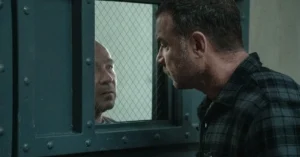
The final confrontation happens in an elevator at a student housing building. Harry anticipates the trap and uses the building’s security cameras to document everything. During the fight, Harry manages to handcuff Waaler’s arm to the elevator door. As the elevator moves, Waaler’s arm is torn off. Badly wounded, he tries to chase Harry down the stairs but bleeds out before he can finish the attack.
Joel Kinnaman spoke about filming the death scene, calling it “very brutal” but in keeping with Nesbø’s writing style.
“This is something I love about Jo’s writing,” Kinnaman said. “He takes it to the extreme. It makes the audience unable to lean back because the potential that something really hard is going to hit you is always there.”
He also praised the practical effects team, noting that the arm severance was done with physical prosthetics layered with visual effects.
The Post-Credits Scene That Changes Everything
After the credits roll, the show delivers one final scene. Harry visits Waaler’s hometown to learn about his past. A store clerk recognizes a photo of Tom and shares details about the abuse Tom suffered from his father. The clerk mentions that Tom’s father died under mysterious circumstances, suggesting Tom may have killed him as a teenager.
This scene adds a layer of complexity to Waaler’s character, showing that the monster Harry faced was shaped by violence from a young age. It does not excuse his actions, but it explains how he became the man he is.
The Masked Woman Reveal and What It Sets Up
The finale also includes a mid-credits scene that sets up a possible second season. A group of masked figures gathers in a room with lavish murals, discussing the fallout from Waaler’s death. One of them removes her mask—it is Agnes Sjolid (Agnes Kittelsen), the Chief Superintendent and Harry’s boss.
Sjolid tells the group that Waaler’s death is a setback, but not a major one. She orders them to regroup and lay low, promising they will “come back stronger.” This confirms that Waaler was not working alone. There is a larger criminal network operating within the police force, and Sjolid is at the center of it.
Earlier in the finale, Sjolid had reinstated Harry as a detective after he was fired for his drinking problem. She told him she needed his help to find “rotten apples” in the department, asking him to stay quiet about Waaler’s weapons operation. Harry agreed, not knowing that she was the one running the operation all along.
This twist recontextualizes the entire season. Harry thought he had won by stopping Waaler, but the real enemy was standing in front of him the whole time.
How the Finale Connects to Nesbø’s Books
The series adapts The Devil’s Star, the fifth book in Nesbø’s Harry Hole series. In the novel, Waaler also dies during a confrontation with Harry, though the circumstances differ. The show skips ahead to this book while incorporating elements from earlier novels, including The Redbreast and Nemesis.
Jo Nesbø himself wrote the series, ensuring it stays true to his vision. In interviews, he has said he is close to ending the book series as well, promising not to resurrect Harry after the final novel.
Audience Reactions and the Show’s Unique Path
Detective Hole did not immediately top Netflix’s global charts, but it has found a dedicated audience. Viewers who stick with the show through the slower early episodes have formed what one article called a “survivor alliance,” using “have you seen the waterbed episode” as a shared reference point.
The series has drawn comparisons to True Detective season one and other Nordic noir classics, praised for its atmosphere and willingness to make viewers uncomfortable. The waterbed scene, in particular, has generated significant discussion online, with many calling it one of the most disturbing moments in recent crime television.
Reddit users noted that the scene’s effectiveness comes from its restraint—no jump scares, no dramatic music, just Harry’s face as he realizes what he is touching. One comment with hundreds of upvotes said, “I paused three times to get through it. Not because I was scared, but because it made me feel sick.”
You May Also Like:






What the Ending Means for Harry
Harry ends the season in a better place than where he started. He has solved the serial killer case, stopped Waaler, and been reinstated to the police force. His relationship with Rakel and Oleg is also repaired, at least for now.
But the final scenes reveal that Harry’s victory is incomplete. The corruption he thought he had removed from the department is still there, hiding behind a face he trusted. Sjolid has him exactly where she wants him—back on the force, believing he has won, while she continues her criminal activities without suspicion.
The post-credits scene in Waaler’s hometown also suggests that Harry is still digging into the past. He is not satisfied with just closing the case. He wants to understand what made Waaler the way he was, which could lead him to uncover more secrets about the network Sjolid controls.
Whether the show returns for a second season has not been confirmed. But with the source material from Nesbø’s novels and the ending clearly setting up more story, it seems likely that Harry Hole’s investigation is far from over.
Stay connected with VvipTimes for more recaps, streaming updates, and breaking entertainment news.
































































Leave a Reply