

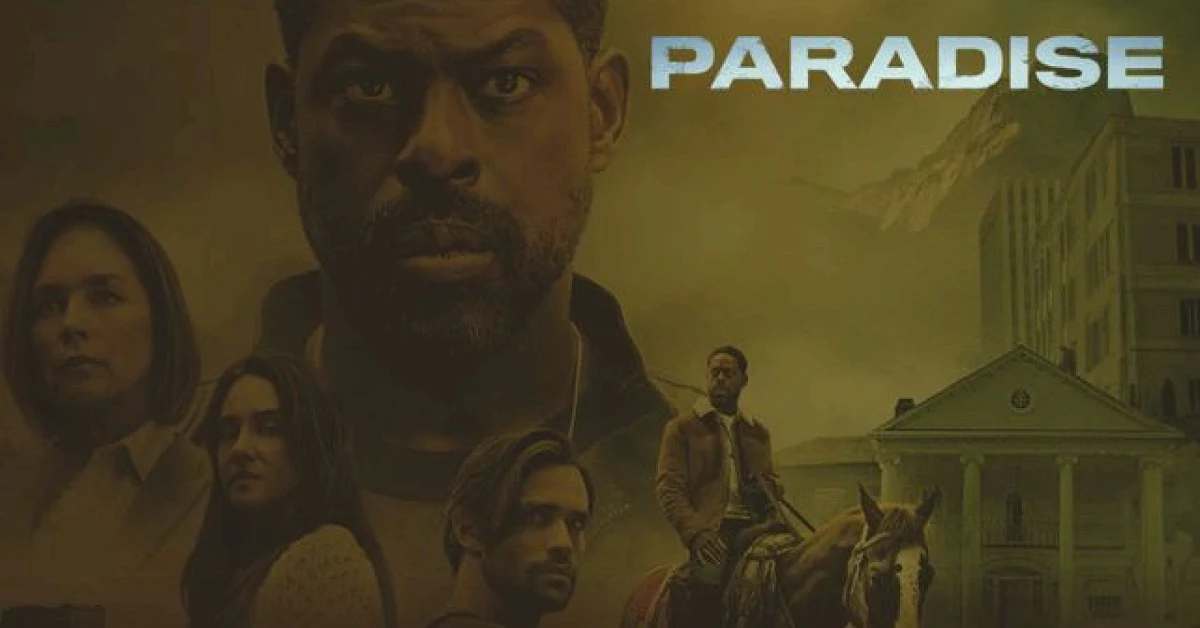
The Hulu series Paradise has become one of the most talked-about shows, pulling viewers into a world where Secret Service agent Xavier Collins, played by Sterling K. Brown, finds President Cal Bradford, portrayed by James Marsden, dead under suspicious circumstances. The show, which premiered in early 2025, quickly grabbed attention with its ending in the first episode that revealed the seemingly perfect community is actually an underground city built inside a mountain. With such a detailed and believable setup, many viewers have been asking a simple question: could any of this actually happen in real life?
The short answer is no—the story of Paradise is not based on true events. Creator Dan Fogelman, known for “This Is Us,” crafted the story entirely from his imagination. However, the show’s creators did something smart. They brought in real experts to make the fictional world feel grounded and believable, mixing science and social theory with a made-up story about a global disaster and the powerful people who survive it.
The Real-Life Spark Behind the Fictional Story
While the plot is not a true story, the initial idea for Paradise came from a very real human experience. Dan Fogelman shared that the concept started over a decade ago after he had a meeting with a very powerful and wealthy businessman. Sitting in the room with someone who had so much money and influence, Fogelman started thinking about what would happen if a sudden disaster struck.
He asked himself a simple question: would the people working for that powerful man stay to protect him, or would they run to save their own families? That question grew into the central conflict of Paradise, where Secret Service agent Xavier Collins must choose between his duty to the President and his love for his own family. The show is not a retelling of a specific event, but it was born from a realistic thought about human nature and loyalty in times of crisis.
Building a Believable World with Expert Help
To make the show’s underground world feel authentic, the production team did not just guess. They brought in experts from several fields to help shape the rules of their fictional society.
Sociologists Wrote the Rules
One of the most interesting behind-the-scenes details is that the creators worked with a sociologist from Boston University named Jonathan Mijs. Fogelman had seen Mijs give a TEDx talk about inequality and reached out to him. The team had a professor of sociology write a 25-page paper on how a society of 25,000 people living underground would actually be governed.
This paper became a guide for the writers and the production designer, Kevin Bird. It helped them decide how the city would look, how people would behave, and what rules would keep the peace. The goal was not to write a textbook, but to make sure the fictional world had a logic that viewers could feel, even if they did not see the rules on screen.
Science That Is Stretched, Not Broken
The show’s main disaster—a supervolcano eruption that triggers a 600-mile-per-hour tsunami and a massive earthquake—was also researched with experts. Fogelman and his team met with scientists who study how the world could end, including experts in psychology, archaeology, and climate science.
They wanted the disaster to be big enough to feel real but far-fetched enough to remain fiction. Ali Mehrizi-Sani, a professor of electrical and computer engineering at Virginia Tech, explained that much of the technology shown in the bunker is based on real engineering principles, just pushed to an extreme level. For example, self-sufficient power grids exist today in places like military installations and even some college campuses. Nuclear submarines already run for decades without refueling. The show took what is currently possible and imagined it on a much larger, more expensive scale.
What the Experts Say Could and Could Not Happen
Virginia Tech experts watched Paradise and broke down which parts of the underground city could actually exist and which are pure fantasy.
What is realistic:
- Building large bunkers is possible. The U.S. already has underground facilities like Cheyenne Mountain in Colorado and the Greenbrier Resort bunker in West Virginia, which was built to house Congress.
- Creating a self-sufficient power and life-support system is within reach using existing technology.
- The amount of money required would be enormous, which matches the show’s story of billionaires funding the project.
What is not realistic:
- The huge open dome space shown in the series is not possible with current rock mechanics. Real underground spaces need pillars and roof bolts to prevent collapse.
- Creating sunlight that feels completely natural with a glowing orb would be nearly impossible. Engineers would likely use high-efficiency LED lights, which would still feel artificial.
- Keeping an underground space clean and tidy with manicured streets and gardens would be extremely difficult and costly.
Fictional Themes That Mirror Real-World Issues
Even though the story is made up, the themes in Paradise touch on real-world problems that many people find relatable.
Who Gets Saved in a Crisis?
The show forces viewers to think about a tough question: when a disaster happens, who gets chosen to survive? In the series, 25,000 people are picked to live in the bunker while millions are left to die. The selection process is controlled by a billionaire who decides who is “essential.”
This idea connects to real events like Hurricane Katrina, where wealth and race played a role in who could evacuate and who was left behind. It also brings up memories of the water crisis in Flint, Michigan, and Jackson, Mississippi, where mostly Black communities suffered from unsafe drinking water while wealthier areas nearby were not affected. While Paradise is science fiction, the show uses its fictional disaster to talk about inequality that already exists.
The Allure of a Perfect Society
The show’s title is meant to be ironic. The underground city is called Paradise, but it is far from perfect. Jonathan Mijs, the sociologist who consulted on the show, said he hopes viewers think about what a perfect community would actually look like and realize that the one in the show, with its hidden secrets and controlling leaders, is not it.
The production designer intentionally made the city feel “creepy-perfect,” taking inspiration from Disney-fied New England architecture to create a place that looks too clean and too organized to be real. This feeling of unease is meant to make viewers question whether a society run by a few powerful people could ever truly be a paradise for everyone.
The Music and World-Building Details
The attention to detail in Paradise goes beyond the science and sociology. Composer Siddhartha Khosla, who also worked on “This Is Us,” created not only the score but also the sounds for the electronic wristbands that residents use to pay for things and receive alerts. He made these sounds using an omnichord, an old synth instrument from the 1980s, to give the show a unique audio identity.
Director John Requa explained that they purposely made the world feel slightly artificial to keep viewers focused on the characters. They even smoothed out cracks in the concrete during post-production to make the city look new and manufactured. The goal was to create a setting that felt just strange enough that viewers would sense something was wrong, without being pulled out of the story.
What the Cast and Creator Say
Sterling K. Brown, who plays Xavier Collins, said he was immediately drawn to the role after reading the pilot script. Fogelman wrote the part with Brown in mind, and Brown was excited to work with the “This Is Us” team again on a very different kind of show.
James Marsden, who plays President Cal Bradford, described his character as someone who tries to do the right thing despite being stuck in a difficult position. He appreciated that the role allowed him to bring some humor to a heavy story.
Fogelman himself has been clear that while the show touches on real issues, his main goal was to tell a good story with surprising turns. He said, “I’m not trying to say something. It’s just this is what’s in the ether right now.”
You May Also Like:










Where to Watch and What to Expect
All episodes of Paradise are available for streaming on Hulu in the United States. For viewers in the United Kingdom and other regions, the series is available on Disney+. The show consists of eight episodes in its first season, with a second season confirmed and currently in production in Los Angeles.
The second season, which began airing in February 2026, continues the story with new locations and challenges. One episode even recreates Elvis Presley’s Graceland mansion, showing how the survivors navigate the world outside the bunker.
Paradise is a work of fiction that uses real-world science and social questions to build its world. It is not based on a true story, but the issues it raises about power, inequality, and survival are very real. The show succeeds because it asks questions that people already think about and places those questions inside a gripping, fast-paced thriller.
Also Read: Why ‘Talamasca: The Secret Order’ Was Canceled After Just One Season on AMC and Netflix
Stay connected with VvipTimes for more updates on the latest TV shows, streaming releases, and everything happening in the world of entertainment.


























































































Leave a Reply